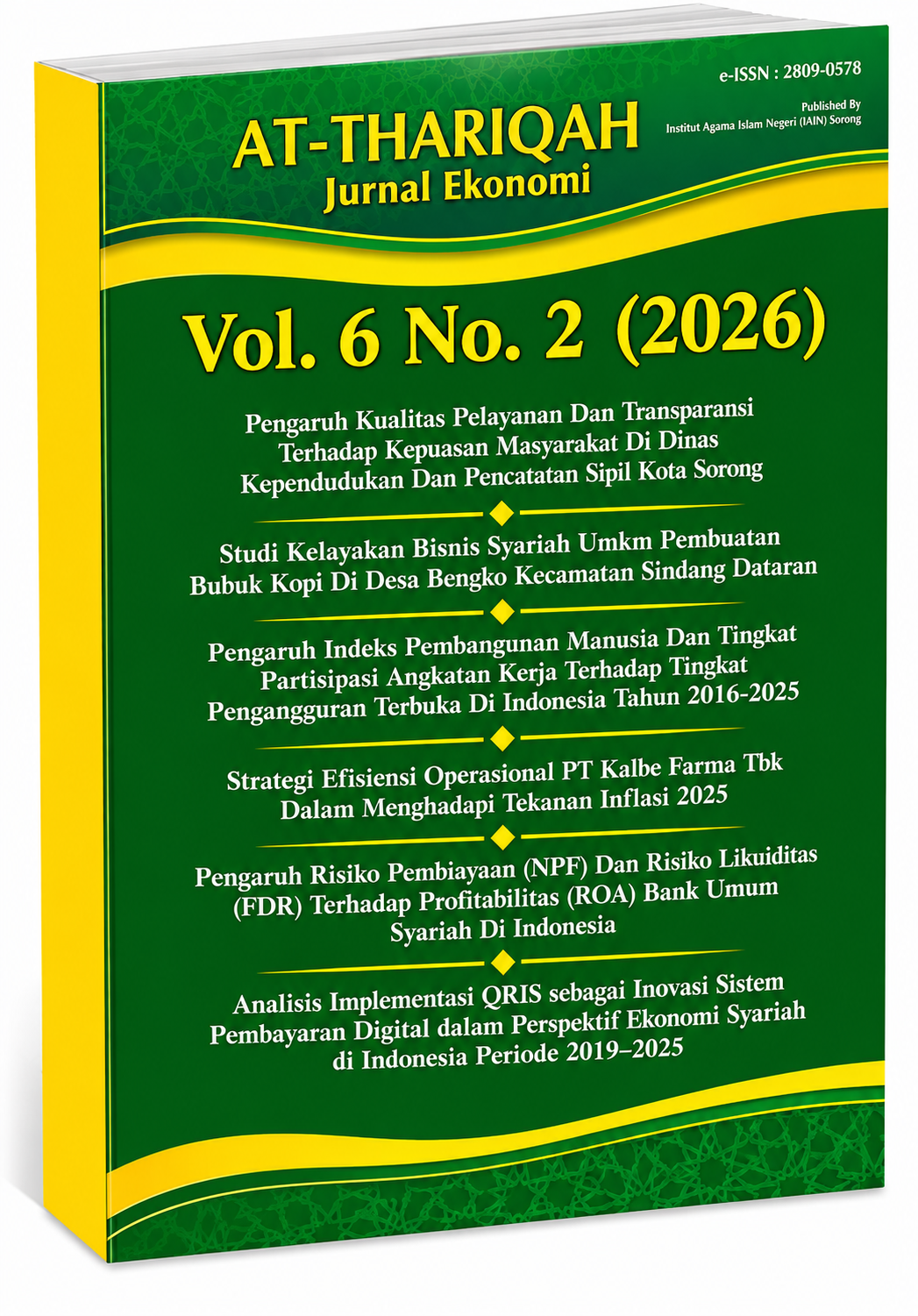
Analisis Implementasi QRIS sebagai Inovasi Sistem Pembayaran Digital dalam Perspektif Ekonomi Syariah di Indonesia Periode 2019–2025
DOI:
https://doi.org/10.47945/at-thariqah.v6i2.3628Keywords:
QRIS, Digital Payment System, , Islamic Economics, Maqashid Syariah, Financial Inclusion.Abstract
This study aims to analyze the development of the implementation of the Quick Response Code Indonesian Standard (QRIS) as a digital payment system innovation in Indonesia during the 2019–2025 period, and to examine its relevance from the perspective of Islamic economics. The method employed is a descriptive qualitative approach, with data collected through documentation studies and literature reviews, drawing from official Bank Indonesia statistics, scientific journals, and supporting documents. The results indicate that QRIS has experienced significant growth, reflected in the increasing number of users, merchants, transaction volumes, and transaction values over the years. Advanced innovations such as QRIS Cross Border, QRIS TUNTAS, and QRIS TAP have further strengthened QRIS as a national digital payment infrastructure. From an Islamic economic perspective, QRIS is considered consistent with muamalah principles, as its transaction mechanism can be categorized as a transparent wakalah bil ujrah contract, free from elements of riba, gharar, and maysir. Furthermore, QRIS contributes to the achievement of maqashid syariah, particularly in the protection of wealth (hifz al-mal) and public welfare (maslahah ‘ammah), while also promoting more equitable Islamic financial inclusion. However, serious attention is needed regarding the clarity of service fee structures, user data protection, and equitable access to technology, so that the benefits of QRIS can be felt fairly by all segments of society.
References
Auda, J. (2008). Maqasid Al-Shariah as Philosophy of Islamic Law: A Systems Approach. III T. https://iiit.org/en/book/maqasid-al-shariah-as-philosophy-of-islamic-law-a-systems-approach
Azhariyah, A., & Maghfirah, I. (2025). Implementasi QRIS dalam Sistem Pembayaran Keuangan Islam pada UMKM di Desa Tambak Timur , Pulau Bawean : Analisis Perspektif Ekonomi Syariah. 4(4), 5740–5748.
Bank Indonesia. (2025). Statistik Sistem Pembayaran Bank Indonesia. https://www.bi.go.id/id/statistik/ekonomi-keuangan/ssp/default.aspx?utm_source=chatgpt.com
Creswell, J. W., & Creswell, J. D. (2018). Research Design: Qualitative, Quantitative, and Mixed Methods Approaches (5th ed.). sage publications.
Holideh, F. (2026). Penggunaan qris sebagai alat pembayaran dalam transaksi digital perspektif ekonomi syariah. 08(01).
Jayanti, P., Putri, N. Y., & Madina, S. N. (2024). Penggunaan Q RIS Oleh UMKM Sebagai Praktik Usaha Dengan Gaya Hidup Cashless Di Era Digitalisasi.
Kusuma, N. R. (2024). Application of Principles and Rules for Non-Cash Transactions Using QRIS Services Maqā ṣ id Al-Shar ī ʿ ah Perspective. 1(3), 176–188. https://doi.org/10.24235/jiesbi.v1i2.133
Miles, M. B., Huberman, A. M., & Saldaña, J. (2014). Qualitative Data Analysis: A Methods Sourcebook (3rd ed.). sage publications.
Moleong, L. J. (2018). Metodologi Penelitian Kualitatif. PT Remaja Rosdakarya.
Nurkhofifah, S., & Kurniati, H. (2025). Sharia Economic Law Perspective on the Contractual Use of Indonesian Standard QR Code ( QRIS ) in Digital Transactions. 25(2).
Rahmah, F. R., Rahayu, N., Damayanti, S., & Armazumi, R. (2024). Penggunaan QRIS Untuk Kemudahan Pembayaran Digital Dari Perspektif Kepuasan Konsumen. 3(1).
Sarif Rini, A. A. (2024). The Innovation of Digital Payment System with QRIS in National Open API and Maqasid al-Sharia Standards. International Journal of Applied Business and International Management, Vol 9, No 2 (2024): August 2024, 251–269.
Sugiyono. (2019). Metode Penelitian kuantitatif, kualitatif dan r&d.
Alfabeta.
Suryawirawan, A. (2025). Transformasi Qris sebagai Instrumen Pembayaran Digital dalam Perspektif Ekonomi Syariah. 4.
Syariah, D., & Mui, N. (n.d.). Dewan Syariah Nasional Majelis Ulama Indonesia. (2017. 19.
Widjaja, G. (2024). MAQASID SYARIAH DALAM REGULASI FINTECH :
Analisis Kritis Kerangka Hukum Ekonomi Islam di Era Digital. 5(1), 23–36.


 Jalan Sorong - Klamono Km. 17 Klablim, Sorong - Papua Barat
 info@iainsorong.ac.id