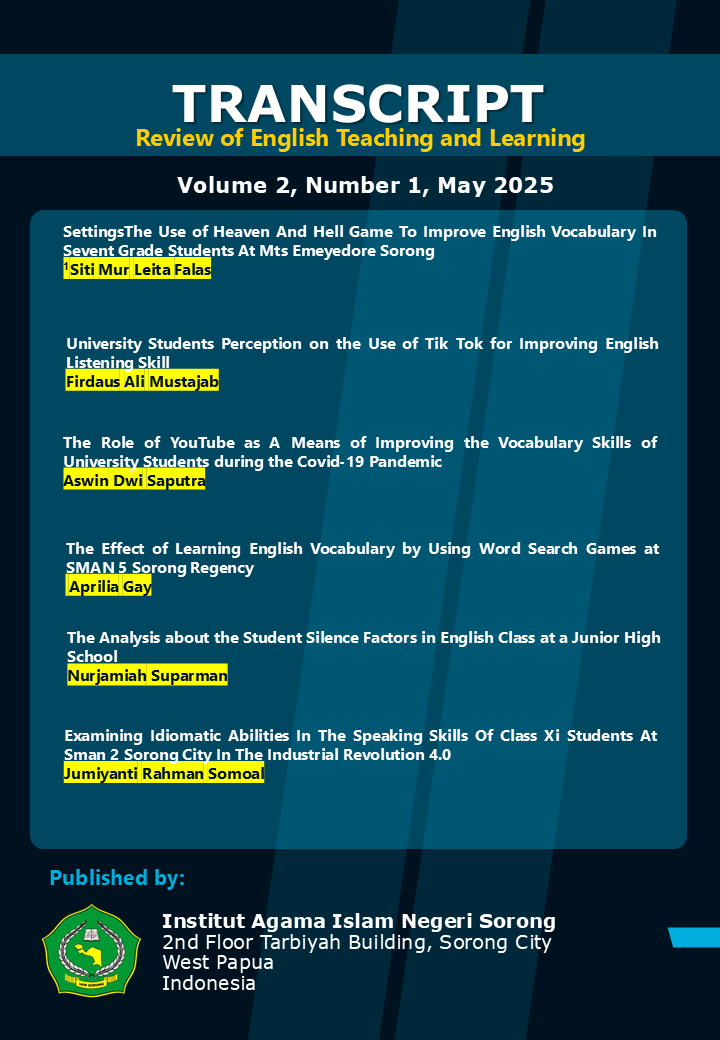
University Students Perception on the Use of Tik Tok for Improving English Listening Skill
Keywords:
Tiktok, English Listening Skills, Social Media in EducationAbstract
This research investigates the perception of students In State Islamic Institute of Sorong regarding with the use of TikTok as a medium for developing English listening skills. English, English plays a vital role in education and the integration of social media into daily life have created new opportunities for language learning. TikTok, a popular social media platform, has been widely used among students for entertainment, but its potential as a tool for educational purposes, particularly in improving listening skills, has not been fully explored. This qualitative study utilizes a descriptive approach, collecting data through observations, interviews, and document analysis. The research focuses on students from the 2020-2022 cohorts of the English Language Education program at In State Islamic Institute Of Sorong. The study aims to know the students choose TikTok as a learning tool and how they use it to enhance their listening skills. The findings indicate that students reveal TikTok as a beneficial tool for learning English, particularly due to its engaging and interactive nature. However, challenges such as limited video duration, lack of pronunciation-focused features, and potential distractions were also identified. Despite these obstacles, the study concludes that TikTok has a positive impact on students' motivation and effectiveness in improving their English listening skills, provided it is integrated with structured learning. This research contributes to the understanding of social media's role in education and offers insights into how platforms like TikTok can be effectively utilized for language learning for listening English. It also highlights the need for educators to guide students in using such tools responsibly and effectively.
References
Alifia, N. (2021). Enhancing speaking skills through TikTok: A study on students’ perspectives. Universitas Islam Negeri Ar-Raniry. https://repository.ar-raniry.ac.id/id/eprint/35734/1/Nabila%20Alifia,%20180203005,%20FTK,%20PBI.pdf
Anisah, Nur, and Miftahulfadlik Dabamona. "Harnessing Social Media for English Language Learning: Insights from an Islamic Senior High School Students in Eastern Indonesia." IDEAS: Journal on English Language Teaching & Learning, Linguistics & Literature 13, no. 1 (2025).
Arra’fu, Muhammad Rafif, Miftahulfadlik Dabamona, and Misnariah Idrus. "Exploring Student Perspectives on Spotify Application in Enhancing Listening Skills: A Case Study in an Indonesian Islamic Junior High School." IDEAS: Journal on English Language Teaching & Learning, Linguistics & Literature 13, no. 1 (2025).
Bakhshaei, M., Alavi, S. S., & Zamanian, H. (2021). The impact of short video content on social media engagement. Journal of Digital Media & Policy, 12(2), 145-160.
Brownell, J. (2021). Listening: Attitudes, principles, and skills (6th ed.). Pearson.
Chapple, C. (2020). TikTok crosses 2 billion downloads after best quarter for any app ever. Sensor Tower.
Cohen, L., Manion, L., & Morrison, K. (2018). Research methods in education (8th ed.). Abingdon: Routledge.
Creswell, J. W., & Poth, C. N. (2018). Qualitative inquiry and research design: Choosing among five approaches. Thousand Oaks, CA: Sage Publications.
Dabamona, Miftahulfadlik, and Andarifa Yunus. "The use of YouTube for learning English: exploring technology-based approach." Interference: Journal of Language, Literature, and Linguistics 3, no. 1 (2022): 68-89.
Encyclopaedia Britannica. (2019). History of writing systems. Retrieved from https://www.britannica.com/topic/writing/History-of-writing-systems.
Field, J. (2020). Listening in the language classroom. Oxford University Press.
Fischer, J. (2021). The role of social media in language learning: A case study on TikTok. International Journal of Language Studies, 15(2), 47-65.
Gilakjani, A. P., & Sabouri, N. B. (2021). Extensive listening in the language learning process. Journal of Language Teaching and Research, 12(4), 589-598.
Goh, C. C. M., & Hu, G. (2020). Listening in the language classroom: Insights from research and practice. In The Cambridge Handbook of Language Learning. Cambridge University Press.
Hemingway, E. (1952). The old man and the sea. Scribner.
Influencer Marketing Hub. (2021). The rise of TikTok in e-commerce. Retrieved from https://influencermarketinghub.com/what-is-tiktok/
Influencer Marketing Hub. (n.d.). What is TikTok? Retrieved from https://influencermarketinghub.com/what-is-tiktok/
Jenkins, T. (2022). Principles of sensory and perceptual systems. Cambridge University Press.
Kiefer, P. T. (2020). The music industry handbook: A guide to understanding music consumption. Cambridge University Press.
Kuo, C.-L., & Chen, Y.-M. (2020). The influence of social media on language learning: A case study of TikTok. Journal of Educational Technology & Society, 23(4), 89-100.
Miftachul Taubah. (2020). Aplikasi TikTok sebagai media pembelajaran maharah kalam. Mu’allim Jurnal Pendidikan Islam, 02(1), 64.
Miles, M. B., Huberman, A. M., & Saldaña, J. (2020). Qualitative data analysis: A methods sourcebook (4th ed.). Thousand Oaks, CA: Sage Publications.
Ni Luh Warini, et al. (2020). Daya tarik TikTok sebagai media pembelajaran bahasa Inggris online. Sintesa Prosiding, ISBN: 978-602-53420-6-6, p. 28.
Omar, B., & Dequan, W. (2020). Watch, share or create: The influence of personality traits and user motivation on TikTok mobile video usage.
Pratiwi, A. E., et al. (2021). Utilizing TikTok application as media for learning English pronunciation. Proceedings International Conference on Education of Suryakancana, p. 382.
Sternberg, R. J., & Sternberg, K. (2022). Cognitive psychology (8th ed.). Cengage Learning.
Vandergrift, L., & Goh, C. C. M. (2020). Teaching and learning second language listening: Metacognition in action. Routledge.
Warini, N. L., Sukma Dewi, N. P. E., Susanto, P. C., & Chrisma Dewi, P. C. (2020). The attraction of TikTok as an online English learning media. Universitas Dhyana Pura.
Downloads
Published
How to Cite
Issue
Section
License
Copyright (c) 2025 Transcript: Review of English Teaching and Learning

This work is licensed under a Creative Commons Attribution 4.0 International License.
As a journal writer, you have the right to various uses of your article, including use by the institution or company where you work. This copyright can be used without special permission.
Publishing authors in TRANSCRIPT: Review of Teaching and Learning English have broad rights to use their work for teaching and scientific purposes without the need to seek permission, including use for classroom teaching by Author or Author institutions and presentations at meetings or conferences and distributing copies to participants; used for internal training by the author's company; distribution to colleagues for their research use; used in compilations of the authors' subsequent works; included in a thesis or dissertation; reuse of sections or excerpts from articles in other works (with full acknowledgement of the final article); preparation of derivative works (other than commercial purposes) (with full acknowledgement of the final article); Voluntary posting on open websites operated by authors or authors' bodies for scientific purposes (follow CC by 4.0 license  ).
).
Authors and readers can copy and redistribute the material in any media or format, as well as remix, modify and build the material for any purpose, even commercially, but they must provide appropriate credit (cite the article or content), provide a link to the license, and indicate if anything changes. If you mix, modify, or build upon the materials, you must distribute your contributions under the same license as the originals.