Psychometric Validation of a Mathematics Self-Belief Instrument Using Secondary Data from Early Childhood Pre-Service Teachers
DOI:
https://doi.org/10.47945/search.v5i1.3224Keywords:
Mathematics Self-Belief, Validity, Reliability, Self-Efficacy, Math Anxiety, Early Childhood Pre-Service TeachersAbstract
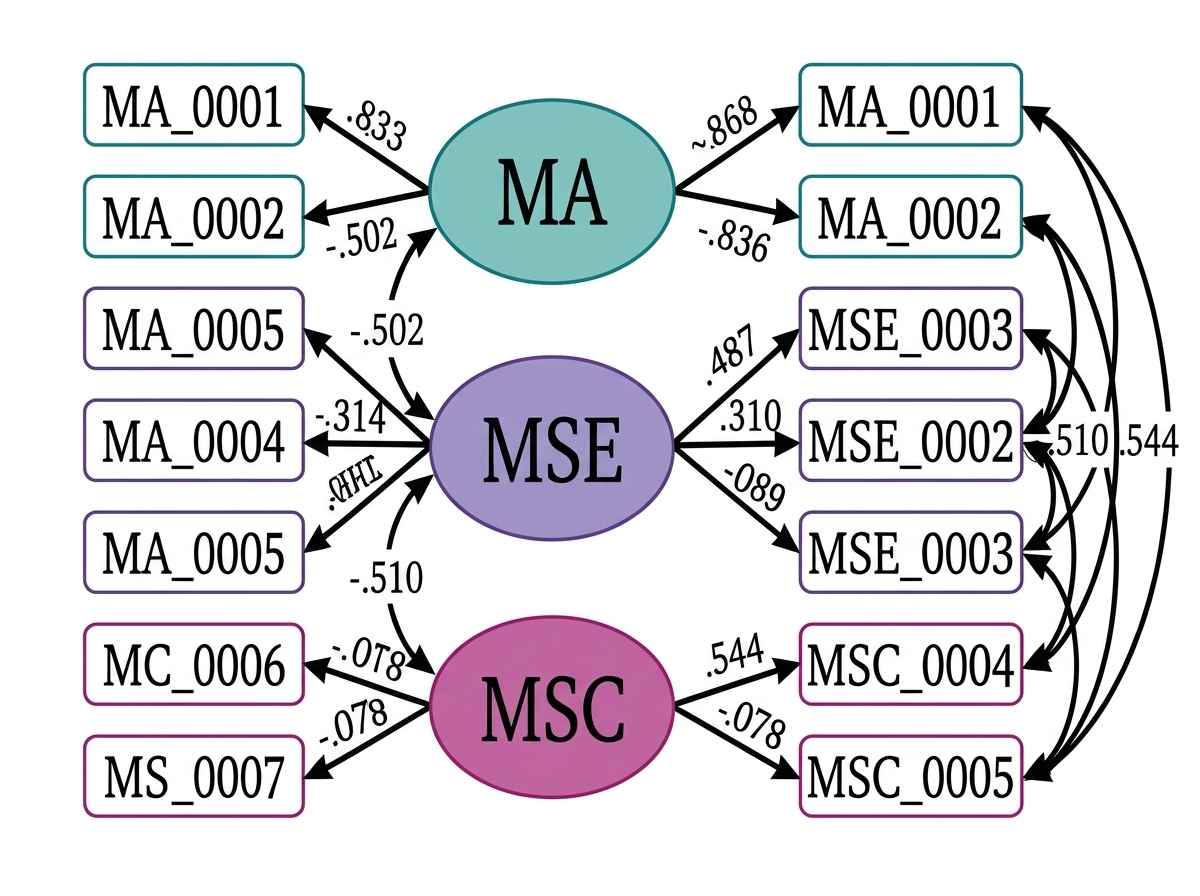
Mathematics self-belief among early childhood pre-service teachers is considered an important factor influencing how they later teach numeracy to young children. However, most existing self-belief instruments were developed and validated in Western contexts, so their psychometric properties warrant re-examination before broader use. This study examined the reliability and factor structure of a mathematics self-belief instrument covering three theoretical dimensions—self-efficacy, self-concept, and mathematics anxiety—through a secondary analysis of Brownlow’s (2020) dataset of 80 early childhood pre-service teachers. Reliability was assessed using Cronbach’s alpha (supplemented with McDonald’s omega), and factor structure was examined using Exploratory Factor Analysis (EFA) with promax rotation. Results indicated good-to-excellent reliability across the three subscales (α = .864–.942) and adequate sampling adequacy for factor analysis (Kaiser-Meyer-Olkin [KMO] = .888; Bartlett’s test significant, p < .001). The factor analysis broadly supported the three-dimensional structure, although self-efficacy items involving more abstract/procedural tasks showed weaker loadings than those framed in narrative contexts. These findings provide preliminary evidence supporting aspects of construct validity, particularly the internal structure of the instrument. Practically, the framing-related pattern suggests that teacher-education programs using this instrument should interpret — and eventually score — self-efficacy items differently depending on how mathematical tasks are framed, rather than treating self-efficacy as a single undifferentiated score.
References
Ashcraft, M. H. (2002). Math anxiety: Personal, educational, and cognitive consequences. Current Directions in Psychological Science, 11(5), 181-185. https://doi.org/10.1111/1467-8721.00196
Bandura, A. (1997). Self-efficacy: The exercise of control. W. H. Freeman.
Barroso, C. (2021). A meta-analysis of the relation between math anxiety and math achievement. Psychological Bulletin, 147(2), 134-168. https://doi.org/10.1037/bul0000307
Becker, M. (2022). Parents' math anxiety and mathematics performance of pre-kindergarten children. Journal of Experimental Child Psychology, 214, 105302. https://doi.org/10.1016/j.jecp.2021.105302
Bosica, J. (2022). Using a mixed methods approach to study the relationship between mathematics anxiety, mathematics teacher efficacy, and mathematics teaching anxiety in preservice elementary school teachers in Ontario. Canadian Journal of Science, Mathematics and Technology Education, 22, 190-209. https://doi.org/10.1007/s42330-022-00203-8
Brownlow, L. (2020). Self-Belief, Confidence and Framed Word Problems: A Study on Early Childhood Pre-Service Teachers. https://doi.org/10.17632/8gtxyz4s3h.1
Cipora, K. (2024). The AMATUS dataset: Arithmetic performance, mathematics anxiety and attitudes in primary school teachers and university students. Journal of Open Psychology Data, 12(1), 9. https://doi.org/10.5334/jopd.115
Cronbach, L. J. (1951). Coefficient alpha and the internal structure of tests. Psychometrika, 16(3), 297-334. https://doi.org/10.1007/BF02310555
Dahlan, J. (2026). Measuring students' self-concept: Instrument development and validation using exploratory factor analysis. Jurnal Pendidikan Matematika dan Sains, 14(2), 424-432. https://doi.org/10.21831/jpms.v14i2.96861
Demedts, F. (2022). Unraveling the role of math anxiety in students' math performance. Frontiers in Psychology, 13, 979113. https://doi.org/10.3389/fpsyg.2022.979113
Edwards, A. A. (2021). Alpha, omega, and H internal consistency reliability estimates: Reviewing these options and when to use them. Counseling Outcome Research and Evaluation, 14(1), 77-88. https://doi.org/10.1080/21501378.2021.1940118
Goretzko, D. (2021). Exploratory factor analysis: Current use, methodological developments and recommendations for good practice. Current Psychology, 40(7), 3510-3521. https://doi.org/10.1007/s12144-019-00300-2
Jiang, R. (2021). How mathematics anxiety affects students' inflexible perseverance in mathematics problem-solving: Examining the mediating role of cognitive reflection. British Journal of Educational Psychology, 91(1), 237-260. https://doi.org/10.1111/bjep.12364
Juniati, D. (2022). The influence of cognitive and affective factors on the performance of prospective mathematics teachers. European Journal of Educational Research, 11(3), 1379-1391. https://doi.org/10.12973/eu-jer.11.3.1379
Kaiser, H. F. (1974). An index of factorial simplicity. Psychometrika, 39(1), 31-36. https://doi.org/10.1007/BF02291575
Lau, N. T. T. (2022). Disentangling the individual and contextual effects of math anxiety: A global perspective. Proceedings of the National Academy of Sciences, 119(7), e2115855119. https://doi.org/10.1073/pnas.2115855119
Lawshe, C. H. (1975). A quantitative approach to content validity. Personnel Psychology, 28(4), 563-575. https://doi.org/10.1111/j.1744-6570.1975.tb01393.x
Mainali, B. (2025). Math anxiety, math performance and role of field experience in preservice teachers. Education Sciences, 15(9), 1227. https://doi.org/10.3390/educsci15091227
Merino-Soto, C. (2023). Aiken's V coefficient: Differences in content validity judgments. MHSalud, 20(1), 23-32. https://doi.org/10.15359/mhs.20-1.3
Park, D. (2024). Effect of preschool teacher's math anxiety on teaching efficacy and classroom engagement in math. Psychology in the Schools. https://doi.org/10.1002/pits.23182
Sakellariou, C. (2022). The reciprocal relationship between mathematics self-efficacy and mathematics performance in US high school students: Instrumental variables estimates and gender differences. Frontiers in Psychology, 13, 941253. https://doi.org/10.3389/fpsyg.2022.941253
Sayah Sayari, N. (2024). Development and validation of the mathematics self-efficacy scale for university students. Research and Development in Medical Education, 13, 16. https://doi.org/10.34172/rdme.33206
Shao, M. (2025). The Chinese adaptation of the Teachers' Sense of Efficacy Scale in early childhood pre-service teachers: Validity, measurement invariance, and reliability. Behavioral Sciences, 15(3), 329. https://doi.org/10.3390/bs15030329
Street, K. E. S. (2024). Students' mathematics self-efficacy: A scoping review. ZDM – Mathematics Education, 56(2), 265-280. https://doi.org/10.1007/s11858-024-01548-0
Szczygieł, M. (2025). Math anxiety, math teaching anxiety, and math attitudes in primary school teachers: A multi-country study. Journal for the Study of Education and Development. https://doi.org/10.1177/14749041251401767
Wang, C. (2024). The effect of student-perceived teacher support on math anxiety: Chain mediation of teacher–student relationship and math self-efficacy. Frontiers in Psychology, 15, 1333012. https://doi.org/10.3389/fpsyg.2024.1333012
Xenofontos, C. (2023). Teachers' self-efficacy in teaching mathematics: Tracing possible changes from teacher education to professional practice. Teachers and Teaching. https://doi.org/10.1080/13540602.2023.2219982
Zakariya, Y. F. (2022). Cronbach's alpha in mathematics education research: Its appropriateness, overuse, and alternatives in estimating scale reliability. Frontiers in Psychology, 13, 1074430. https://doi.org/10.3389/fpsyg.2022.1074430
Živković, M. (2023). Math self-efficacy or anxiety? The role of emotional and motivational contribution in math performance. Social Psychology of Education, 26(3), 579-601. https://doi.org/10.1007/s11218-023-09760-8