Improving Students' Note-Taking Discipline in Chemistry Learning Through Reward and Punishment
DOI:
https://doi.org/10.47945/search.v5i1.3267Keywords:
Chemistry Learning, Note-taking Discipline, Record-Keeping, Reward and Punishment, Student DisciplineAbstract
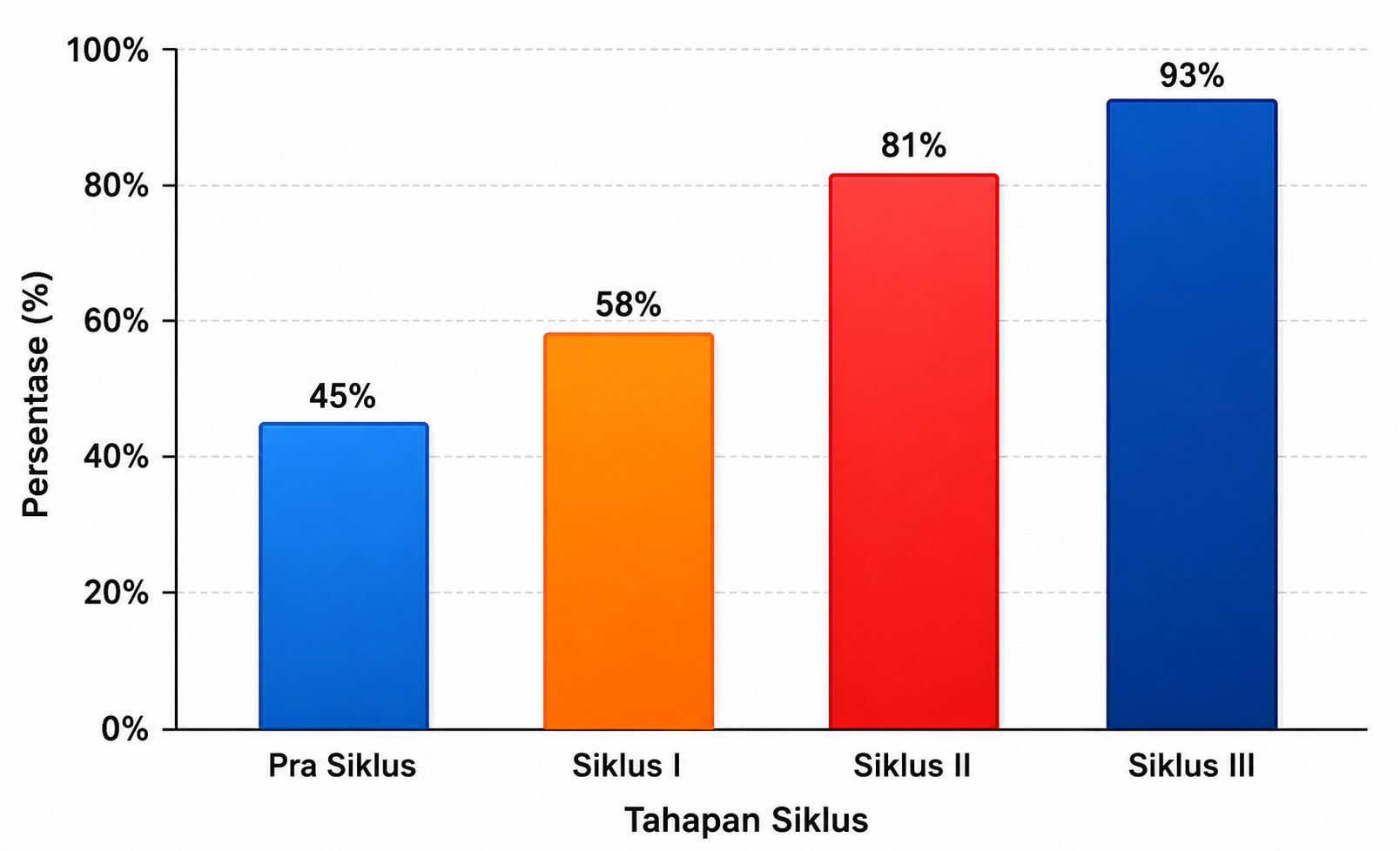
Discipline in taking notes is one of the academic behaviors that supports understanding of concepts and learning retention, especially in Chemistry learning which has the characteristics of abstract, hierarchical, and interrelated material. The results of initial observations show that most students have not completed the notes completely and have not collected them on time. This condition shows the need for a learning strategy that is able to form more disciplined learning habits. This research aims to improve students' discipline in taking notes through the application of rewards and punishments in Chemistry learning. The study employed Kemmis and McTaggart's Classroom Action Research (CAR) model, conducted in three cycles involving 32 students of Class X E1 at SMAN 1 Situjuah Limo Nagari. Data were collected using an observation sheet assessing two indicators: the completeness of students' notes in accordance with the learning material and the timeliness of note submission. The data were analyzed descriptively using the percentage of students achieving both indicators in each cycle, and the action was considered successful when at least 85% of students met the predetermined discipline criteria. The results showed that students' discipline in note-taking discipline gradually increased from 45% in the pre-cycle to 58% in the first cycle, 81% in the second cycle, and 93% in the third cycle. Improvements occurred in both observed indicators, showing that the consistent application of rewards and punishments through cycles of action and reflection effectively strengthened students' discipline in taking notes. Thus, reward and punishment strategies can be applied as an alternative to improve positive academic behavior, especially the discipline of note-taking, in Chemistry learning.
References
Anggraini, S., Siswanto, J., & S. (2019). Analisis dampak pemberian reward and punishment bagi siswa SD Negeri Kaliwiru Semarang 7(3), 221–229. https://doi.org/10.23887/jjpgsd.v7i3.19393. MIMBAR PGSD Undiksha, 7(3), 221–229.
Arshad, A. M., Halim, L., & Nasri, N. M. (2021). Effect of self-regulated learning strategies on students’ achievement in science: A meta-analysis. Asia-Pacific Forum on Science Learning and Teaching, 21(1).
Dunlosky, J., Rawson, K. A., Marsh, E. J., Nathan, M. J., & Willingham, D. T. (2013). Improving students’ learning with effective learning techniques: Promising directions from cognitive and educational psychology. Psychological Science in the Public Interest, 14(1), 4–58. https://doi.org/https://doi.org/10.1177/1529100612453266
Edisherashvili, N., Saks, K., Pedaste, M., & Leijen, Ä. (2022). Supporting self-regulated learning in distance learning contexts at higher education level: Systematic literature review. Frontiers in Psychology, 12 792422. https://doi.org/https://doi.org/10.3389/fpsyg.2021.792422
Elindasari, D. A. (2021). Pengaruh Reward dan Punishment terhadap Kedisiplinan Belajar Siswa.
Fadilah, S. N., & Nasirudin, F. (2021). Implementasi reward dan punishment dalam membentuk karakter disiplin peserta didik di Madrasah Ibtidaiyah Al-Hidayah Jember. EDUCARE: Journal of Primary Education, 2(1), 87–100. https://doi.org/https://doi.org/10.35719/educare.v2i1.51
Fajra, A. E., Ysh, A. Y. S., & Ardiyanto, A. (2025). The influence of reward and punishment on the IPAS learning outcomes of fourth-grade students at SD Al Khotimah, Semarang City. IQRO: Journal of Islamic Education, 7(2). https://doi.org/10.24256/iqro.v7i2.8589
Ghrinsky, R. H., Syarif, M. Z. H., & Alfaien, N. I. (2025). Penerapan sanksi dan reward dalam meningkatkan kedisiplinan siswa di Madrasah Tsanawiyah. Idarah Tarbawiyah: Journal of Management in Islamic Education, 6(4), 445–458. https://doi.org/10.32832/itjmie.v6i4.19988
Indrawati, I., Marzuki, M., Syafi'urrohman, S., & Malik, A. R. (2020). Investigating the effect of reward and punishment on the students' learning achievement and discipline. Linguistic, English Education and Art (LEEA) Journal, 4(1), 337–350
Johnstone, A. H. (1993). The development of chemistry teaching: A changing response to changing demand. Journal of Chemical Education, 70(9), 701–705. https://doi.org/https://doi.org/10.1021/ed070p701
Kadioglu-Akbulut, C., & Uzuntiryaki-Kondakci, E. (2021). Implementation of self-regulatory instruction to promote students' achievement and learning strategies in the high school chemistry classroom. Chemistry Education Research and Practice, 22(1), 12–29. https://doi.org/10.1039/C9RP00297A
Kemmis, S., McTaggart, R., & Nixon, R. (2014). The action research planner: Doing critical participatory action research. Springer. https://doi.org/10.1007/978-981-4560-67-2
Kobayashi, K. (2005). What limits the encoding effect of note-taking? A meta-analytic examination. Contemporary Educational Psychology, 30(2), 242–262. https://doi.org/https://doi.org/10.1016/j.cedpsych.2004.10.001
Kurniasih, N., Arafat, Y., & M. (2021). Pengaruh reward dan punishment terhadap kedisiplinan siswa. Indonesian Journal of Education, Innovation and Technology, 2(2), 136–143.
Morehead, K., Dunlosky, J., & Rawson, K. A. (2019). How much mightier is the pen than the keyboard for note-taking? A replication and extension of Mueller and Oppenheimer. Educational Psychology Review, 31(3), 753–780. https://doi.org/https://doi.org/10.1007/s10648-019-09468-2
Mueller, P. A., & Oppenheimer, D. M. (2014). The pen is mightier than the keyboard: Advantages of longhand over laptop note taking. Psychological Science, 25(6), 1159–1168. https://doi.org/https://doi.org/10.1177/0956797614524581
Munawwarah, M., & Agussalim, H. (2026). Instructional Approaches for Fostering Self-Regulated Learning in Chemistry Education: A Systematic Literature Review. Jurnal Pendidikan Dan Pembelajaran Kimia, 15(1), 20–, 20–36.
Muthia, dkk. (2025). Application of problem based learning assisted by reward and punishment to improve
self-regulation of junior high school students. Jurnal IPA & Pembelajaran IPA.
Nuraisah, S., Yeni, R., & Rizqa, M. (2023). Effectiveness of reward and punishment on student learning
discipline. LITERACY: International Scientific Journals of Social, Education, Humanities, 2(2).
https://doi.org/10.56910/literacy.v2i2.1064
Panadero, E. (2017). A review of self-regulated learning: Six models and four directions for research. Frontiers in Psychology, 8, 422. https://doi.org/https://doi.org/10.3389/fpsyg.2017.00422
Purba, O. S., & Purba, F. J. (2023). Penerapan reward and consequences sebagai upaya untuk melatih kedisiplinan siswa di dalam kelas. Journal of Chemistry and Education Research, ChemER, 7(1).
Rosanna, D. L., & Hajijah, A.Rosanna, D. L., & Hajijah, A. (2022). The effect of rewards and punishment on student learning motivation on stoichiometry material. Lavoisier: Chemistry Education Journal.
Skinner, B. F. (1953). Science and human behavior. Macmillan.
Trianto. (2010). Mendesain model pembelajaran inovatif-progresif: Konsep, landasan, dan implementasinya pada Kurikulum Tingkat Satuan Pendidikan (KTSP). Kencana.
Zimmerman, B. J. (2002). Becoming a self-regulated learner: An overview. ,. Theory Into Practice, 41(2), 64–70. https://doi.org/https://doi.org/10.1207/S15430421TIP4102_2