The Effect of Baamboozle-Based Learning Media on Grade X Students’ Mathematics Learning Interest in Statistics
DOI:
https://doi.org/10.47945/search.v5i1.3361Keywords:
Baamboozle, Learning Interest, Learning Media, Mathematics LearningAbstract
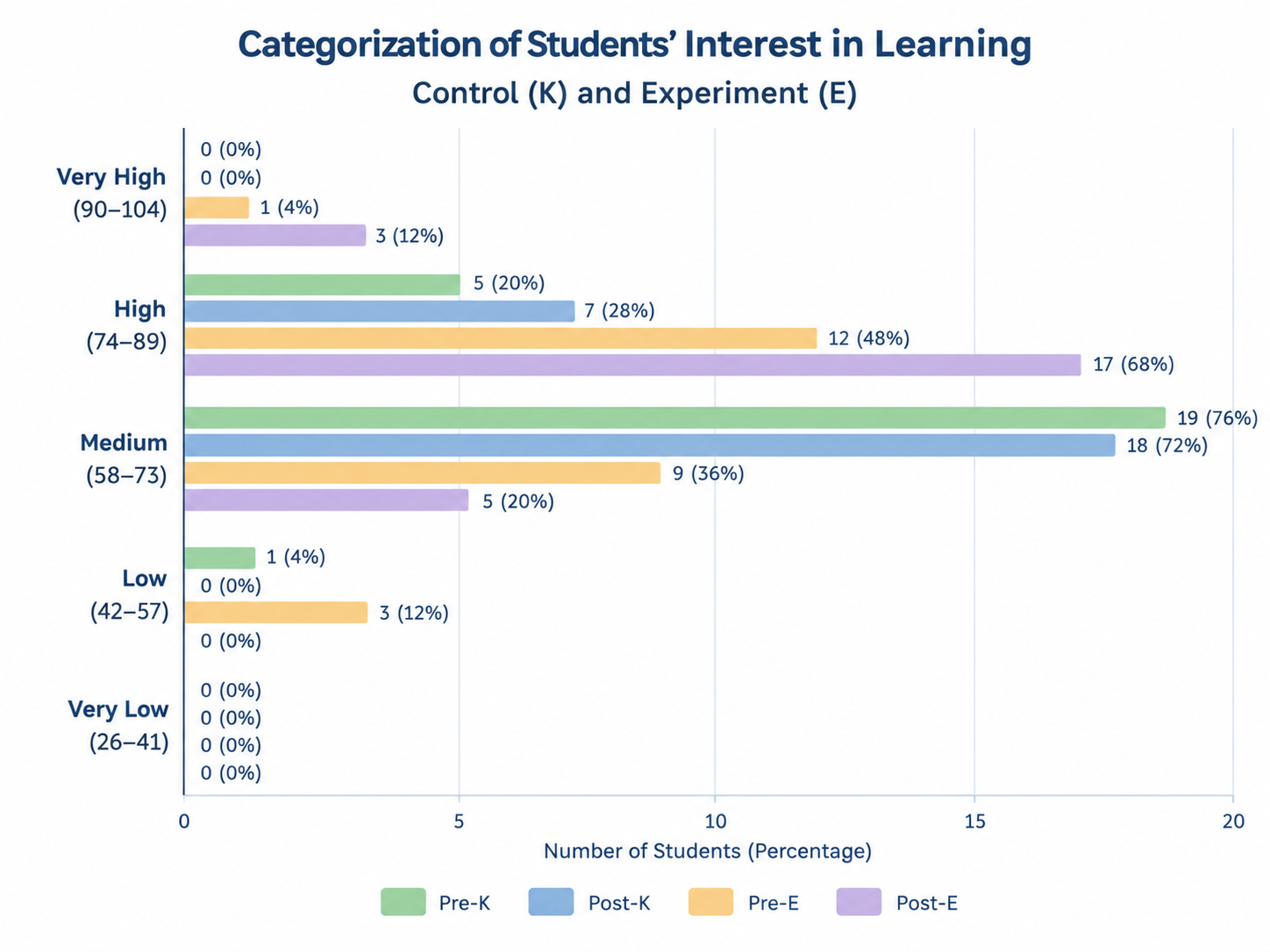
This research was motivated by the low active participation of students in mathematics learning at SMAS Diponegoro Tumpang, which was still dominated by one-way lecture methods. This study aimed to determine the effect of Baamboozle-based learning media on the mathematics learning interest of grade X students on the material of mean of single and grouped data. A quasi-experimental method with a nonequivalent control group design was used, involving an experimental class (X-D) using Baamboozle and a control class (X-C) using PowerPoint, each analyzed from 25 students determined through cluster random sampling. Data were collected using a validated and reliable 26-item Likert-scale learning interest questionnaire (Cronbach's Alpha = 0.889) and analyzed using Analysis of Covariance (ANCOVA), with post-test scores as the dependent variable and pre-test scores as the covariate, after the normality, homogeneity, and regression-slope-homogeneity assumptions were checked. Descriptively, the mean learning interest of the experimental class increased by 6.00 points (72.60 to 78.60), compared with a 2.32-point increase in the control class (67.48 to 69.80); because the experimental class already scored 5.12 points higher than the control class before treatment, this descriptive gain was interpreted with caution and the pre-test difference was statistically controlled through ANCOVA before any effect was inferred. The ANCOVA showed a significant effect of learning media on post-test learning interest after controlling for pre-test scores, F(1,47) = 16.687, p < 0.001, partial η² = 0.262. These findings tentatively suggest that game-based learning media such as Baamboozle may help foster mathematics learning interest relative to conventional instruction, particularly on statistics topics, although the single-school, two-class design limits how far this conclusion can be generalized.
References
Afidah, N., & Subekti, F. E. (2024). Efektivitas penggunaan game edukasi digital terhadap hasil belajar matematika siswa. Jurnal Basicedu, 8(3), 1944–1952. https://doi.org/10.31004/basicedu.v8i3.7564
Alfitra, D., & Ain, S. Q. (2025). Pengaruh minat belajar terhadap hasil belajar matematika siswa kelas 5 SDN 002 Koto Baru Singingi Hilir Kuantan Singingi. Indonesian Journal of School Counseling, 10(1), 164–173. https://doi.org/10.23916/085813011
Alotaibi, M. S. (2024). Game-based learning in early childhood education: A systematic review and meta-analysis. Frontiers in Psychology, 15. https://doi.org/10.3389/fpsyg.2024.1307881
Aulia, G., Amran, A., & Saputra, R. R. H. (2025). The effect of Baamboozle media on students’ interest in learning mathematics at MI Nurul Huda. Jurnal Al-Muta’aliyah: Pendidikan Guru Madrasah Ibtidaiyah, 5(2), 105–114. https://doi.org/10.51700/mutaaliyah.v5i2.1025
Erşen, Z. B., & Ergül, E. (2022). Trends of game-based learning in mathematics education: A systematic review. International Journal of Contemporary Educational Research, 9(3), 603–623. https://doi.org/10.33200/ijcer.1109501
Hii, B. H., & Mahmud, M. S. (2023). Influence of game-based learning in mathematics education on the students’ cognitive and affective domain: A systematic review. Frontiers in Psychology, 14, 1105806. https://doi.org/10.3389/fpsyg.2023.1105806
Hilda, & Prasetyaningtyas, F. D. (2024). The effectiveness of Baamboozle game as a learning media for flat geometry in improving students’ problem-solving skills. Journal for Lesson and Learning Studies, 7(3), 533–543. https://doi.org/10.23887/jlls.v7i3.82754
Indrawan, T. A. P., & Munahefi, D. N. (2025). Kemampuan komunikasi matematis ditinjau dari self-confidence melalui model Teams Games Tournament berbantuan Baamboozle. Circle: Jurnal Pendidikan Matematika, 5(2), 143–159. https://doi.org/10.28918/circle.v5i2.10355
Khoiro, D. (2023). Penerapan media Bamboozle dalam meningkatkan motivasi belajar di SMAN 1 Pamarayan. Edusociata Jurnal Pendidikan Sosiologi, 6(1), 509–520. https://doi.org/10.33627/es.v6i1.1457
Mardiah, K., Dwi Syaputri, M., & Rezki Rihansyah, M. (2024). Penerapan Kuis Edukatif Baamboozle dalam meningkatkan motivasi belajar siswa kelas IV pada mata pelajaran matematika. Jurnal CERDAS Proklamator, 12(2), 184–198. https://doi.org/10.37301/cerdas.v12i2.273
Nurhikmah, N., Rustiani, S., & Nurdin, N. (2024). Literature review: Media game edukasi interaktif dalam pembelajaran matematika. Journal of Education Research, 5(4), 4382–4390. https://doi.org/10.37985/jer.v5i4.1573
Nuryadi, Astuti, T. D., Utami, E. S., & Budiantara, M. (2017). Dasar-dasar statistik penelitian. Sibuku Media.
Nuryanti, A., & Nurjanah, H. F. (2025). Efektivitas pengembangan media pembelajaran game edukasi berbasis Baamboozle pada mata pelajaran matematika di SMA Negeri 1 Jalaksana. Indo-MathEdu Intellectuals Journal, 6(5), 8287–8295. https://doi.org/10.54373/imeij.v6i5.3990
Putri, F. M., & Safrizal. (2023). Faktor penyebab rendahnya minat belajar siswa dalam pembelajaran matematika kelas VI Sekolah Dasar Negeri 12 Baruh-Bukit. Jurnal Riset Madrasah Ibtidaiyah (JURMIA), 3(1), 66–77. https://doi.org/10.32665/jurmia.v3i1.1346
Ratnasari, D., Sucipto, L., Syawahid, M., & Kasim, M. (2026). How effective is game-based educational platform on students’ learning interest and mathematics problem-solving skills? Empirical evidence from Islamic boarding school. Beta: Jurnal Tadris Matematika, 19(1). https://doi.org/10.20414/betajtm.v19i1.762
Resti, R., Wati, R. A., Ma’Arif, S., & Syarifuddin, S. (2024). Pemanfaatan media pembelajaran berbasis teknologi sebagai alat untuk meningkatkan kemampuan literasi digital siswa sekolah dasar. Al Madrasah Jurnal Pendidikan Madrasah Ibtidaiyah, 8(3), 1145. https://doi.org/10.35931/am.v8i3.3563
Sailer, M., & Homner, L. (2020). The gamification of learning: A meta-analysis. Educational Psychology Review, 32, 77–112. https://doi.org/10.1007/s10648-019-09498-w
Slameto. (2015). Belajar dan faktor-faktor yang mempengaruhinya (Ed. Revisi). Rineka Cipta.
Sugiyono. (2023). Metode penelitian kuantitatif, kualitatif, dan R&D. Alfabeta.
Vankúš, P. (2021). Influence of game-based learning in mathematics education on students’ affective domain: A systematic review. Mathematics, 9(9), 986. https://doi.org/10.3390/math9090986
Wahyuningsih, E., Hidayati, F. H., Muflih, G. Z., & Fersellia, F. (2024). Problem-based learning with Baamboozle edugame: Enhancing critical thinking skills and learning interest. Journal of Advanced Sciences and Mathematics Education, 4(2), 113–124. https://doi.org/10.58524/jasme.v4i2.477
Wardani, M. E., & Kiptiyah, S. M. (2024). Game-based learning model with Baamboozle media based on artificial intelligence increases student engagement and learning outcomes. Jurnal Ilmiah Sekolah Dasar, 8(2), 293–303. https://doi.org/10.23887/jisd.v8i2.67141