Design of Acid-Base Electronic Magazine (E-Chemagz) to Enhance Grade 11 High School Students' Chemical Literacy
DOI:
https://doi.org/10.47945/search.v5i1.3418Keywords:
E-Chemagz, Acid–Base, Chemical Literacy, Formative EvaluationAbstract
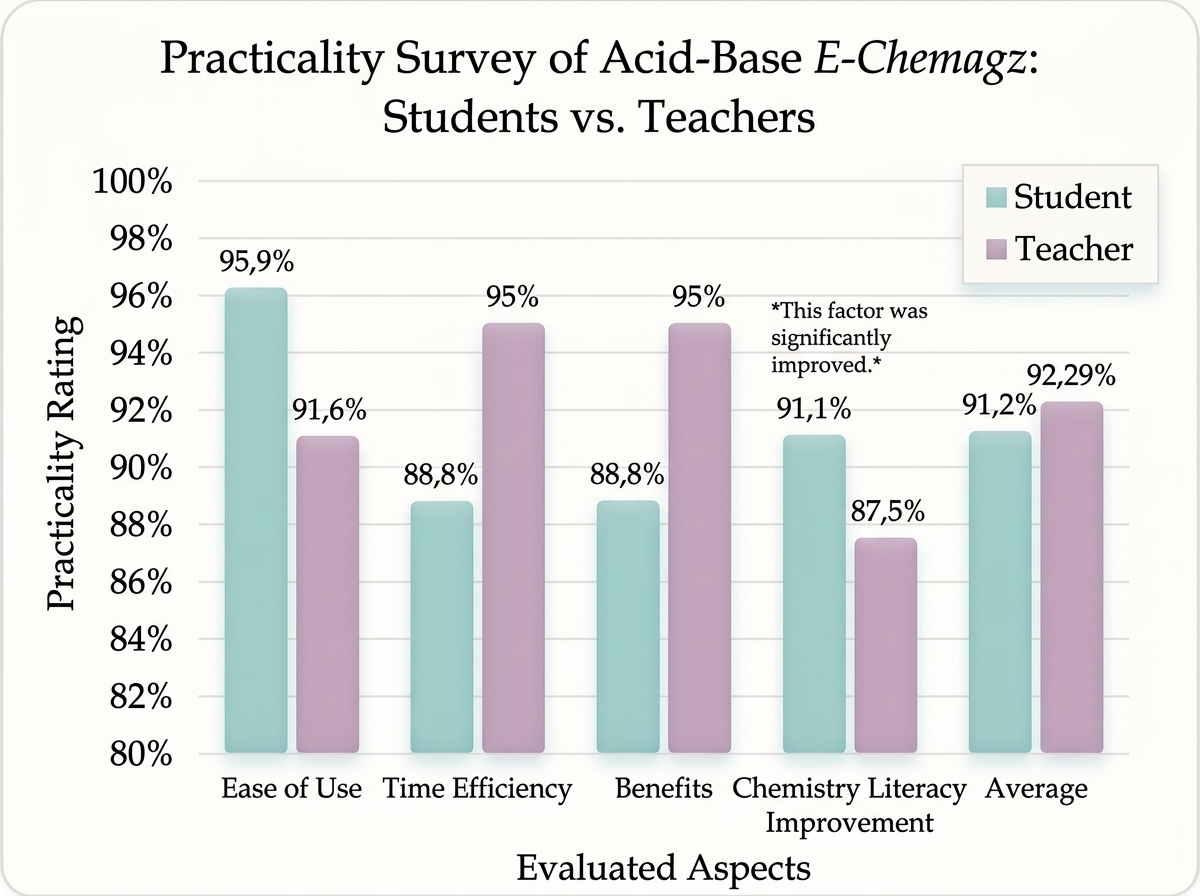
Students' chemical literacy regarding the topic of acids and bases remains relatively low, as this subject requires an integrated understanding of macroscopic, microscopic, and symbolic levels. Therefore, this study aimed to design an "Electronic Chemistry Magazine" (E-Chemagz) on acids and bases a valid and practical resource to enhance the chemical literacy of Phase F (high school/Islamic high school) students. The study employed the Educational Design Research (EDR) methodology, following the Plomp model, which resulted in the development of a four prototype (Prototype IV). The prototype development phase adhered to a formative evaluation process, consisting of self-evaluation, expert review, one-to-one evaluation, and small-group evaluation. The validity assessment was conducted by a panel of experts, including three lecturers from the Department of Chemistry at the Faculty of Mathematics and Natural Sciences (FMIPA) of Universitas Negeri Padang (UNP) and two chemistry teachers from a public high school in Padang. The practicality assessment involved two chemistry teachers and nine Phase F students from a public high school in Padang. Data were collected using validity and practicality questionnaires. Validity results were analyzed using Aiken’s V formula, while practicality results were analyzed based on the percentage of the product's practicality achievement scores. The findings indicate that the Aiken’s V values for each aspect ranged from 0.8 to 0.9, falling into the "valid" category. Furthermore, the average practicality scores provided by the teachers and students were 93.17% and 91.15%, respectively, placing the resource in the "highly practical" category. These assessment results demonstrate that the E-Chemagz on acids and bases is both valid and practical for improving the chemical literacy of Phase F high school students. Consequently, this E-Chemagz resource is ready to proceed to an effectiveness test to measure its impact on enhancing the chemical literacy of Phase F students.
References
Aiken, L. R. (1985). Three Coefficients For Analyzing The Reliability And Validity Of Ratings. Educational And Psychological Measurement. https://psycnet.apa.org/doi/10.1177/0013164485451012
Akker, J. van den, Bannan, B., Kelly, A. E., Nieveen, N., & Plomp, T. (2013). Educational Design Research Part A: An introduction (T. Plomp & N. Nieveen (eds.)). Kogan Page.
Alifat, Z. Z., Yerimadesi, Iryani, & Yuhelman, N. (2025). Effectiveness of Atomic Structure Module Based on Guided Discovery Learning Integrated with TPACK Towards Improving Chemical Literacy Ability Of Students Of Phase E in High School. PAKAR Pendidikan, 23.
Arsyad, A. (2017). Media Pembelajaran. Rajawali Pers.
Averill, B., & Eldredge, P. (2011). General Chemistry: Principles, Patterns, and Applications. Saylor Foundation.
Badan Pengembangan dan Pembinaan Bahasa. (2021). Pedoman Umum Ejaan Bahasa Indonesia.
BSKAP. (2025). Capaian Pembelajaran Pada Pendidikan Anak Usia Dini, Jenjang Pendidikan Dasar, Dan Jenjang Pendidikan Menengah.
Cahyani, G. A., Wigati, I., & Pratiwi, R. Y. (2024). Application of Chemistry E-Magazine Media to Students’ Interest in Learning in Public Senior High School. ORBITAL: Jurnal Pendidikan Kimia, 8, 71–78.
Cigdemoglu, C., Arslan, H. O., & Cam, A. (2017). Argumentation to foster pre-service science teachers’ knowledge, competency, and attitude on the domains of chemical literacy of acids and bases. Chemistry Education Research and Practice, 18(December 2016), 288–303. https://doi.org/10.1039/C6RP00167J
Dewi, A. C. (2024). Peran Teknologi Dalam Meningkatkan Kualitas Pembelajaran Di Era Digital. Jurnal Riset Guru Indonesia, 3(3), 165–170.
Direktorat Pembinaan SMA. (2017). Panduan praktis penyusunan e-modul. Kementerian Pendidikan dan Kebudayaan.
Fahmina, S. S., Indriyanti, N. Y., Setyowati, W. A. E., Masykuri, M., & Yamtinah, S. (2019). Dimension of Chemical Literacy and its Influence in Chemistry Learning. Journal of Physics: Conference Series. https://doi.org/10.1088/1742-6596/1233/1/012026
Gultom, F. K., Haryati, S., & S, L. A. (2022). Pengembangan Majalah Kimia Elektronik E-Chemagz Menggunakan Flip Pdf Professional Pada Materi Ikatan Kimia. Jurnal Pendidikan Kimia Universitas Riau, 7(2), 74–87.
Hafifah, H., Yerimadesi, Alizar, & Kurniawati, D. (2025). Development of Acid Base E-Module Based on Guided Discovery Learning to Improve Digital Literacy Skills of Senior High School Phase F Students. Jurnal Penelitian Pendidikan IPA, 7(11).
Hall, J. E. (2016). Guyton and Hall Textbook of Medical Physiology. Elsevier Health Sciences.
Hirzi, N., & Ibrahim, M. M. (2025). Inovasi Media Pembelajaran Dalam Meningkatkan Keterlibatan Siswa Dengan Teknologi Interaktif Di Sekolah. Proceeding International Seminar on Islamic Studies, 6(1), 2591–2597.
Jespersen, N. D., & Brady, J. E. (2012). Chemistry The Molecular Nature of Matter (6th ed.). Library of Congress Cataloging-in-Publication Data.
Junaedi, R. A. (2025). Pengantar Produksi Media. Mafy Media Literasi Indonesia.
Kristanto, A. (2016). Media pembelajaran. Penerbit Bintang Sutabaya.
Kurniawan, M. A. B., & Noer, A. M. (2024). Literature Review : Improving Science Through Chemistry Learning Media Literacy Skills. Jurnal Pendidikan Kimia Undiksha, 8(2), 21–29.
Kusuma, R. S. dan Y. (2010). Mudahnya Bikin Majalah. PT Grasindo.
Lumadya, S. A., & Wiyarsi, A. (2024). Identifikasi Miskonsepsi Asam Basa Dengan Three-Tier Multiple Choice Test Menggunakan Certainty Response Index. Jurnal Riset Pembelajaran Kimia, 9, 93–99.
Marbun, K. R. L., Siregar, M., Boangmanalu, M. M., Simamora, L., Silaban, R. G. P., & Saragih, J. R. (2025). Analisis Penggunaan Media Pembelajaran Digital dalam Meningkatkan Pemahaman Konsep Siswa pada Pembelajaran Kimia. PENDIPA Journal of Science Education, 9(2), 502–506.
Mayer, R. E. (2009). Multimedia Learning (2nd ed.). Cambridge University Press.
Munir. (2017). Pembelajaran Digital. Alfabeta.
Novitasari, D., & Suyanta. (2026). Analisis Kebutuhan e-Chemistry Magazine Berbasis STSE Berorientasi Self-Regulated Learning. Jurnal Riset Pembelajaran Kimia, 11, 11–22.
OECD. (2026). PISA 2025 Results (Volume I): Vol. I (Issue Volume I). OECD Publishing.
Petrucci, R. H., Herring, F. G., Madura, J. D., & Bissonnette, C. (2011). General Chemistry. Pearson Canada Inc.
Putra, Y. I., Fadli, R., & Dahry, S. (2023). Meta analyzing the ease of use of e-modules in learning. Jurnal Inovasi Teknologi Pendidikan, 10(4).
Rahayu, S. (2017). Mengoptimalkan Aspek Literasi Dalam Pembelajaran Kimia Abad 21. Prosiding Seminar Nasional Kimia, 21, 1–16.
Riduwan. (2007). Skala pengukuran variabel-variabel penelitian. Alfabeta.
Shwartz, Y., Ben-zvi, R., & Hofstein, A. (2006). The use of scientific literacy taxonomy for assessing the development of chemical literacy among high-school students. Educational Research, 7(4), 203–225.
Sjostrom, J., Yavuzkaya, M., Guerrero, G., & Eilks, I. (2024). Critical Chemical Literacy as a Main Goal of Chemistry Education Aiming for Climate Empowerment and Agency. Journal of Chemical Education. https://doi.org/10.1021/acs.jchemed.4c00452
Sudianti, N., J, F. Y., Zen, Z., Darmansyah, Mirshad, E., & Desky, A. H. A. (2025). The Effectiveness of Using Chemistry Literacy-Based Learning Videos on the Problem-Solving Ability of Grade X Students at SMA Negeri 16 Batam. Jurnal Penelitian Pendidikan, 11(10), 382–388. https://doi.org/10.29303/jppipa.v11i10.12182
Sudirman, R. J., Yerimadesi, Andromeda, Riga, & Yuhelman, N. (2025). Development of Acid-Base E-Modules Based on Guided Discovery Learning Using React Native to Improve Problem Solving Skills of Phase F High School Students. Jurnal Penelitian Pendidikan IPA, 11(7), 934–946. https://doi.org/10.29303/jppipa.v11i7.12212
Tarawi, O., Noer, A. M., & Linda, R. (2020). The development of acid-base e-chemistry magazine as interactive teaching materials. Journal of Physics: Conference Series. https://doi.org/10.1088/1742-6596/1440/1/012012
Tro, N. J. (2011). Introductory Chemistry. Pearson Education.
Wulandari, A. Y. R., Tamam, B., & Fikryah, A. (2025). Media Cetak dan Implementasinya dalam Pembelajaran IPA. Bayfa Cendekia Indonesia
Yerimadesi, Andromeda, Guspatni, Fauziah, Febrila, P. Z., & Makrooni. (2026). The Influence Of Gender And Problem-Based Learning Model On Students’ Numerical Literacy In Chemistry. Jurnal Pendidikan IPA Indonesia, 15(1), 141–155. https://doi.org/10.15294/jpii.v15i1.37300
Yuliani, G., Dianhar, H., & Suhendar, A. (2022). Kimia SMA/MA Kelas XII. Kementerian Pendidikan, Kebudayaan, Riset, dan Teknologi.
Yulianti, R. N. E., Permanasari, A., & Heliawati, L. (2019). Pemanfaatan E-Book Konsep Asam Basa Dalam Pembelajaran Kimia Untuk Meningkatkan Literasi Kimia Siswa SMA Kelas XI. Journal of Science Education, 3(1999), 33–41.
Zulfarina, Syafii, W., & Putri, D. G. (2021). E-Magazine Based on Augmented Reality Digestive as Digital Learning Media for Learning Interest. Journal of Education Technology, 5(3), 417–424.