Analyzing Student Needs for Teams Games Tournament (TGT)-Integrated Worksheets on the Periodic Table of Elements
DOI:
https://doi.org/10.47945/search.v5i2.3449Keywords:
Needs Analysis, Student Worksheet, Periodic Table Of Elements, Teams Games Tournament, Conceptual UnderstandingAbstract
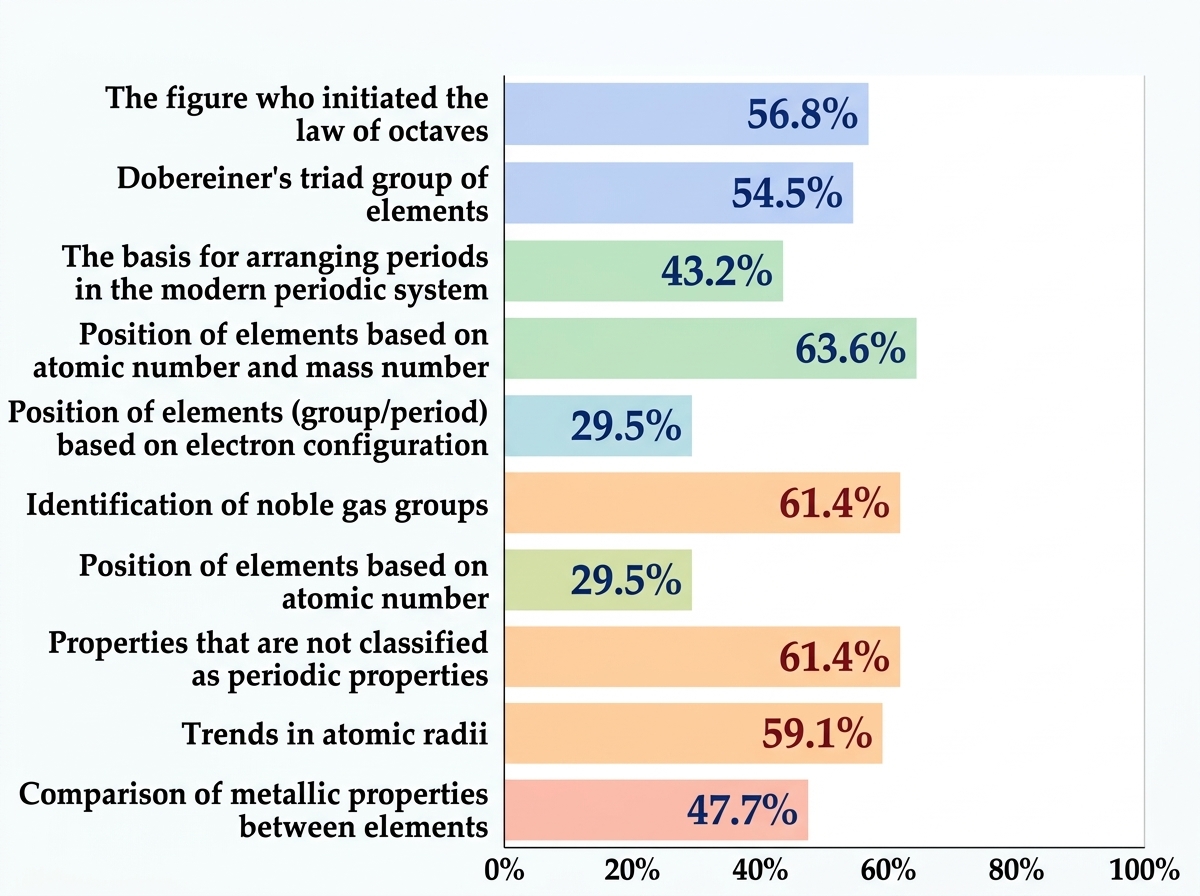
The periodic table of elements is hierarchical: students must translate electron configuration into group and period positions before they can interpret periodic-property trends, yet the teachers interviewed reported that the student worksheets (LKPD) in use do not scaffold this sequence or use tournament-based cooperative learning. This descriptive front-end analysis examined the need for a worksheet based on the Teams Games Tournament (TGT) cooperative learning model, using a questionnaire and a ten-item multiple-choice test (44 10th-grade students), interviews with two chemistry teachers, and score records from two schools in Padang. Concept mastery was uneven (29.5%–63.6% correct) and lowest for translating electron configuration into group/period position (29.5%). Distractor analysis showed that on the atomic-number item 54.5% of students chose the correct period but the wrong group, which points to difficulty in deriving the group from valence electrons rather than in locating the period, although an inter-item effect cannot be excluded. Only 16 of 50 students (32.0%) reached the completion criterion (KKTP 80). Students strongly favored group learning (84.1%) and game elements (86.4%), yet 63.6% said competition between groups reduced their involvement. The findings support a TGT-integrated worksheet that sequences activities from electron configuration to element position before periodic properties, and that uses ability-matched tournament tables instead of open competition between groups.
References
A’yuningsih, D. Q., Suardana, I. N., & Suwenten, I. M. (2017a). Penerapan Model Pembelajaran Kooperatif Tipe Tgt ( Teams Games Tournament ) Untuk Meningkatkan Motivasi Dan Hasil Belajar Peserta Didik. Pendidikan Kimia Indonesia, 1.
A’yuningsih, D. Q., Suardana, I. N., & Suwenten, I. M. (2017b). Penerapan model pembelajaran kooperatif tipe TGT (Teams Games Tournament) untuk meningkatkan motivasi dan hasil belajar peserta didik. Jurnal Pendidikan Kimia Indonesia, 1(2), 37–47. https://doi.org/10.23887/jpk.v1i2.12810
Amni, Z., Ningrat, H. K., & Raehanah. (2021). Pengaruh Model Pembelajaran Kooperatif Tipe Teams Games Tournament ( Tgt ) Berbantuan Media Destinasi Terhadap Motivasi Dan Hasil Belajar Pada Materi Larutan Penyangga. Inovasi Pendidikan Kimia, 15(2), 2840–2848.
Anggraeni, V., Muharram, & Alimin. (2018). Pengaruh permainan ular tangga dalam model pembelajaran kooperatif tipe TGT terhadap motivasi dan hasil belajar kimia siswa kelas X SMA Negeri 1 Masamba (studi pada materi pokok struktur atom dan tabel periodik unsur). CHEMICA: Jurnal Ilmiah Kimia Dan Pendidikan Kimia, 19(1), 96–106. https://doi.org/10.35580/chemica.v19i1.6654
Ardiansyah, B. (2014). Penggunaan media pembelajaran “Monosimpur” (Monopoli Sistem Periodik Unsur-Unsur) melalui strategi pembelajaran kooperatif tipe Team Game Tournament (suatu upaya peningkatan prestasi belajar kimia SMA di kelas X). Hydrogen: Jurnal Kependidikan Kimia, 2(1), 166–170. https://doi.org/10.33394/hjkk.v2i1.645
Aslamiah, S., Pardede, A., & Wardhani, R. R. A. A. K. (2020). Perbandingan problem based learning (PBL) dengan kooperatif tipe TGT (Team Game Tournament) menggunakan media permainan SOS terhadap hasil belajar siswa pada materi asam basa. Dalton: Jurnal Pendidikan Kimia Dan Ilmu Kimia, 3(2). https://doi.org/10.31602/dl.v3i2.3910
Astuti, A. D., Larasati, C. N., & Parubak, A. S. (2019). Perbandingan model pembelajaran dan aktivitas belajar terhadap hasil belajar kognitif peserta didik kelas X IPA SMA Negeri 2 Manokwari pada materi sistem periodik unsur. Arfak Chem: Chemistry Education Journal, 2(2), 142–147. https://doi.org/10.30862/accej.v2i2.287
Chen, O., Paas, F., & Sweller, J. (2023). A cognitive load theory approach to defining and measuring task complexity through element interactivity. Educational Psychology Review, 35, 63. https://doi.org/https://doi.org/10.1007/s10648-023-09782-w
Devi, S., Edi, R., & Sofia. (2024). Pengaruh penerapan model pembelajaran problem based learning terhadap hasil belajar siswa kelas X pada materi sistem periodik unsur. Jurnal Penelitian Pendidikan Kimia: Kajian Hasil Penelitian Pendidikan Kimia, 11(2), 132–141. https://jppk.ejournal.unsri.ac.id/index.php/jurpenkim/article/view/23652
Ho, J. C.-S., Hung, Y.-S., & Kwan, L. Y.-Y. (2022). The impact of peer competition and collaboration on gamified learning performance in educational settings: A meta-analytical study. Education and Information Technologies, 27(3), 3833–3866. https://doi.org/10.1007/s10639-021-10770-2
Hsb, P. S., & Alizar. (2025). Pengembangan LKPD Berbasis Team Game Tournament ( TGT ) pada Materi Ikatan Kimia Fase F SMA / MA. 6, 1731–1739.
Johnstone, A. H. (1991). Why is science difficult to learn? Things are seldom what they seem. Journal of Computer Assisted Learning, 7(2), 75–83. https://doi.org/10.1111/j.1365-2729.1991.tb00230.x
Kala, N., & Ayas, A. (2023). Effect of instructional design based on cognitive load theory on students’ performances and the indicators of element interactivity. Journal of Turkish Science Education, 20(3), 468–489. https://doi.org/10.36681/tused.2023.027
Karimi, H. (2026). A study of common student misconceptions in the topic of electronic configuration. Research in Chemistry Education. https://doi.org/10.48310/chemedu.2026.21388.1386
Karsini, R., & Ritonga, P. S. (2020). Desain dan uji coba lembar kerja peserta didik (LKPD) berbasis probing-prompting pada materi sistem periodik unsur. Jurnal Riset Pendidikan Kimia, 10(1), 53–63. https://doi.org/10.21009/JRPK.101.08
Kisdiono, T. F. (2023). Deskripsi pemahaman konseptual siswa pada konsep struktur atom dan sistem periodik unsur (SPU). Arfak Chem: Chemistry Education Journal, 6(2), 535–540. https://doi.org/10.30862/accej.v6i2.548
Mahmudah, S., Yuridka, F., & Mashuri, M. T. (2019). Komparasi pembelajaran kimia menggunakan metode Teams-Games Tournament dan Team-Assisted Individualization terhadap hasil belajar pada materi ajar tata nama senyawa kelas X SMA Negeri 12 Banjarmasin. Dalton: Jurnal Pendidikan Kimia Dan Ilmu Kimia, 2(1). https://doi.org/10.31602/dl.v2i1.1995
Meffa, D. K., & Afrianis, N. (2026). Pengaruh model TGT berbantuan aplikasi Wordwall terhadap hasil belajar siswa pada materi sistem periodik unsur. Konfigurasi: Jurnal Pendidikan Kimia Dan Terapan, 10(2), 11–18. https://doi.org/10.24014/konfigurasi.v10i2.40064
Munawaroh, S., Nuswowati, M., & Susatyo, E. B. (2016). Pengaruh pembelajaran team games tournament berbantuan crossword puzzle terhadap hasil belajar. Jurnal Inovasi Pendidikan Kimia, 10(1), 1672–1682. https://doi.org/10.15294/jipk.v10i1.6013
Necor, D. C. (2018). Exploring students’ level of conceptual understanding on periodicity. JPAIR Multidisciplinary Research, 33(1), 136–154. https://doi.org/10.7719/jpair.v33i1.609
Nopiyanita, T., Haryono, H., & Ashadi, A. (2013). Penerapan model pembelajaran kooperatif tipe Teams Games Tournament (TGT) untuk meningkatkan prestasi belajar kimia dan kreativitas siswa pada materi reaksi redoks kelas X semester genap SMA Negeri 3 Sukoharjo tahun pelajaran 2012/2013. Jurnal Pendidikan Kimia (JPK), 2(4), 135–141. https://jurnal.fkip.uns.ac.id/index.php/kimia/article/view/2863
Nurhayati, N., & Aini, S. (2025). Analisis kebutuhan media pembelajaran e-LKPD berbasis problem based learning (PBL) pada materi sistem periodik unsur berbantuan Liveworksheet. Science: Jurnal Inovasi Pendidikan Matematika Dan IPA, 5(4). https://jurnalp4i.com/index.php/science/article/view/7547
Pardosi, A. C., & Hutabarat, W. (2015). Implementing problem based learning integrated with cooperative learning teams games tournament in improving students’ achievement in teaching colloidal system. Jurnal Penelitian Bidang Pendidikan, 21(1). https://doi.org/10.24114/jpbp.v21i1.2992
Putri, N. N., & Alizar. (2025). Validitas LKPD berbasis Team Games Tournament pada materi struktur atom untuk kelas X fase E SMA. Journal of Global Research Education, 2(2), 111–117. https://doi.org/10.62194/wtww1849
Ratinho, E., Figueiredo, M., Estêvão, M. D. M. A. O., Faísca, L., & Martins, C. (2026). Gamification on mathematics engagement and motivation in secondary school and higher education: A systematic review and meta-analysis. Educational Psychology Review, 38. https://doi.org/10.1007/s10648-025-10108-1
Ruhulessin, S., Ratumanan, T. G., & Tamalene, H. (2019). Perbedaan Hasil Belajar Siswa Kelas X Sma Menggunakan Model Pembelajaran Kooperatif Tipe Student Facilitator and Explaining (Sfe) Dan Model Pembelajaran Konvensional Pada Materi Trigonometri. JUPITEK: Jurnal Pendidikan Matematika, 2(1), 1–6. https://doi.org/10.30598/jupitekvol2iss1pp1-6
Rusdiansyah, Nurlaili, & Muflihah. (2021). Perbedaan hasil belajar antara siswa yang diajar dengan model pembelajaran teams games tournament - media TTS dan siswa yang diajar dengan model pembelajaran langsung - media TTS pada pokok bahasan tata nama senyawa. Bivalen: Chemical Studies Journal, 4(1), 9–12. https://jurnal.fkip.unmul.ac.id/index.php/bivalen/article/download/720/470
Setiaji, S. N. P. (2022). Pengembangan e-module berbasis problem solving pada konsep konfigurasi elektron [Universitas Islam Negeri Sunan Gunung Djati Bandung]. https://digilib.uinsgd.ac.id/53204/
Slavin, R. E. (1982). Cooperative Learning: Student Teams. What Research Says to The Teacher. Library of Congress Cataloging in Publication Date.
Slavin, R. E. (1995). Cooperative learning: Theory, research, and practice (2nd ed.). Allyn & Bacon.
Sukarsih, N. K. A., Wardhani, R. R. A. A. K., & Mashuri, M. T. (2018). Pengembangan kartu remi kimia menggunakan model pembelajaran TGT (Teams Games Tournament) terhadap hasil belajar siswa pada materi pokok sistem koloid kelas XI SMA Korpri Banjarmasin. Dalton: Jurnal Pendidikan Kimia Dan Ilmu Kimia, 1(1), 16–22. https://doi.org/10.31602/dl.v1i1.1497
Susanna. (2017). Penerapan Teams Games Tournament (TGT) melalui kartu domino pada materi minyak bumi siswa kelas XI MAN 4 Aceh Besar. Lantanida Journal, 5(2), 93–105. https://doi.org/10.22373/lj.v5i2.2832
Susilawati, L., Ramdhani, E. P., & Yulita, I. (2020). Analisis kesulitan belajar siswa kelas X MIPA pada materi sistem periodik unsur di SMAN 1 Teluk Bintan. Student Online Journal (SOJ) UMRAH, 1(2), 500–506. https://soj.umrah.ac.id/index.php/SOJFKIP/article/view/599
Treagust, D. F. (1988). Development and use of diagnostic tests to evaluate students’ misconceptions in science. International Journal of Science Education, 10(2), 159–169. https://doi.org/10.1080/0950069880100204
Virgiawan, W., Nahadi, & Kusrijadi, A. (2020). Profil miskonsepsi siswa SMA negeri di Kota Bandung pada materi konsep mol menggunakan tes diagnostik two-tier berbasis piktorial. Jurnal Riset Dan Praktik Pendidikan Kimia, 8(2), 55–63. https://ejournal.upi.edu/index.php/JRPPK/article/download/52297/26659
Vygotsky, L. S. (1978). Mind in society: The development of higher psychological processes. Harvard University Press.
Widodo, A. T., Sunarto, W., & Afiatun, H. (2016). Pengaruh penggunaan model pembelajaran kooperatif tipe Team Games Tournament berbantuan media kartu terhadap hasil belajar kimia kelas XI SMA N 1 Tengaran. Jurnal Inovasi Pendidikan Kimia, 5(2). https://doaj.org/article/8d7e46d68fc84d7e8466a0db6cab96b9
Yanida, F., & Iswendi. (2018). Efektivitas media permainan ludo berbasis chemo-edutainment untuk meningkatkan hasil belajar siswa pada materi sistem periodik unsur kelas X SMAN 5 Padang tahun pelajaran 2018/2019. Menara Ilmu: Jurnal Penelitian Dan Kajian Ilmiah, 12(12), 30–37. https://doi.org/10.33559/mi.v12i12.1085
Yanti, R. (2024). Analisis miskonsepsi siswa menggunakan tes diagnostik four-tier pada materi sistem periodik unsur [Universitas Islam Negeri Sultan Syarif Kasim Riau]. https://repository.uin-suska.ac.id/84809/
Zumaroh, E., Widana, I. D., & Muliani, L. H. (2017). Penerapan model pembelajaran kooperatif tipe teams games tournament (TGT) pada pembelajaran kimia untuk meningkatkan motivasi dan hasil belajar siswa. Jurnal Pendidikan Kimia Indonesia, 1(1), 30–36. https://doi.org/10.23887/jpk.v1i1.12809