Developing a Problem Based Interactive E-Module Integrating Zero Waste Principles for Learning About Environmental Change
DOI:
https://doi.org/10.47945/search.v5i1.3543Keywords:
Interactive E-Module, Problem Based Learning, Environmental Literacy, Zero Waste, Environmental ChangeAbstract
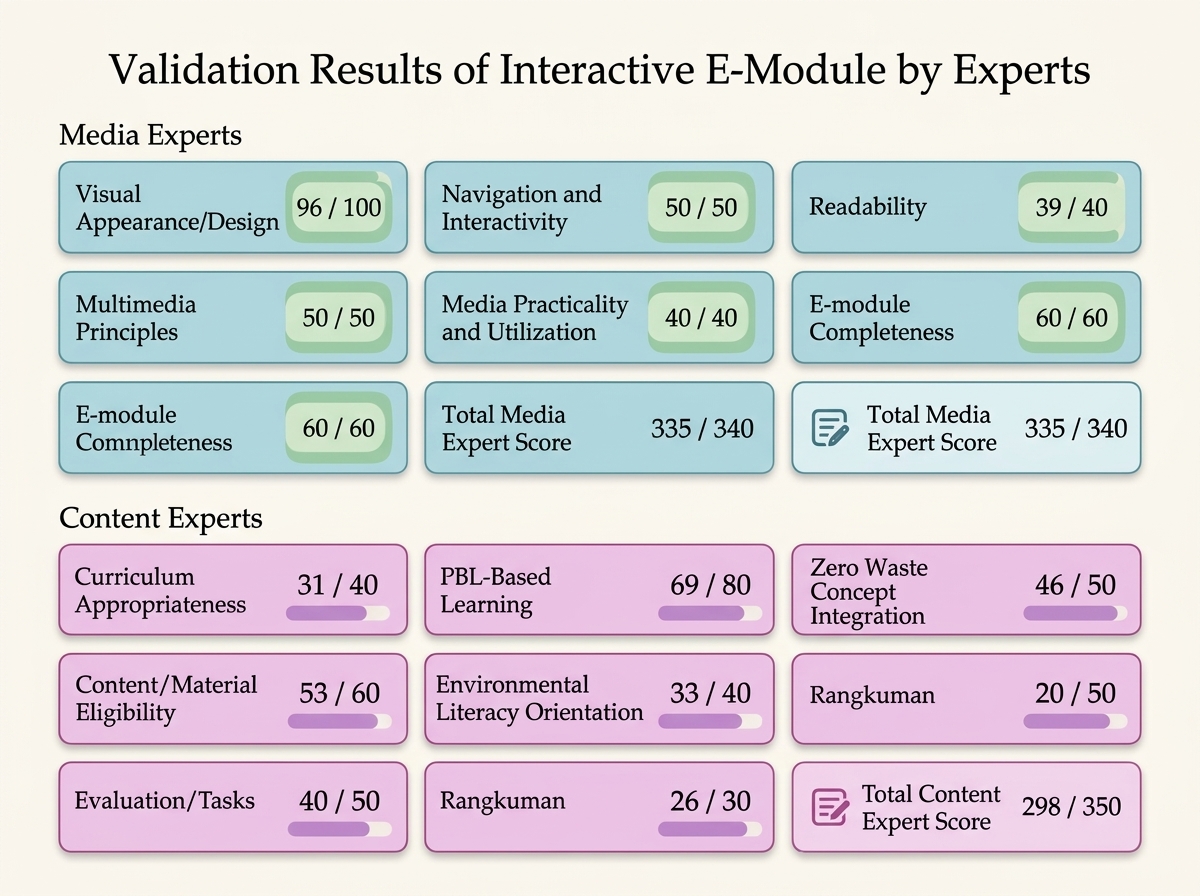
Environmental change learning benefits from contextual digital resources. This study developed an interactive e-module integrating Problem Based Learning and zero waste principles, oriented toward environmental literacy, and evaluated its validity and practicality. Development followed the ADDIE model, using local waste problems within problem based learning activities and the 5R principles to guide solution formulation. Instrument content validity coefficients were calculated using Gregory's method, whereas product validity percentages were derived from assessments by two media experts and two subject matter experts. After revisions, practicality was assessed through responses from three biology teachers and 15 Grade 10 students, including three participants in individual trials and 12 in a small group trial. Media and subject matter validity reached 98.53% and 85.14%, respectively, both categorized as highly valid. Subject matter validation comprised five highly valid aspects and two valid aspects, namely curriculum alignment and assessment tasks. Practicality reached 91.67% for teachers, 92.78% for individual trials, and 92.01% for the small group trial, all categorized as highly practical. These findings support consideration of the e-module as a supplementary digital learning resource based on expert assessments and limited user responses. Its effectiveness in improving learning outcomes, problem solving skills, or environmental literacy remains untested.
References
Akbar, M., & Suhartini, S. (2026). Pengembangan e-modul perubahan lingkungan berbasis Problem Based Learning pada isu Sungai Batanghari untuk meningkatkan literasi lingkungan dan kemampuan berpikir kritis siswa. Cetta: Jurnal Ilmu Pendidikan, 9(3), 283–299. https://doi.org/10.37329/cetta.v9i3.5597
Anggraini, N., & Nazip, K. (2022). Kemampuan literasi lingkungan mahasiswa pendidikan biologi menggunakan skor NELA. Journal of Education Action Research, 6(4), 552–557. https://doi.org/10.23887/jear.v6i4.46975
Anggyani, T., Ilhami, A., Ilahi, P. R., Marlisa, W., Hayati, I., & Sari, W. K. (2023). E-modul berbasis literasi lingkungan pada materi ekosistem untuk meningkatkan literasi lingkungan siswa. Journal of Natural Science Learning, 2(2), 1–7. https://jom.uin-suska.ac.id/index.php/JNSL
Arends, R. I. (2012). Learning to teach (9th ed.). McGraw-Hill.
Bidahyani, R. Y., Utami, S. D., & Dewi, I. N. (2024). Efektivitas model problem based learning (PBL) berorientasi kearifan lokal pada materi keanekaragaman hayati terhadap literasi lingkungan siswa. Empiricism Journal, 5(2), 509–518. https://doi.org/10.36312/ej.v5i2.2316
Branch, R. M. (2009). Instructional design: The ADDIE approach. Springer. https://doi.org/10.1007/978-0-387-09506-6
Daniyarti, W. D. (2022). Pendidikan literasi lingkungan sebagai penunjang pendidikan akhlak lingkungan. Tamaddun Journal of Islamic Studies, 1(2), 89–101. https://doi.org/10.55657/tajis.v1i2.43
Dinas Kehutanan dan Lingkungan Hidup Provinsi Bali. (2025, August 27). Pemprov Bali genjot percepatan pengelolaan sampah, terapkan strategi hulu-hilir. https://dklh.baliprov.go.id/pemprov-bali-genjot-percepatan-pengelolaan-sampah-terapkan-strategi-hulu-hilir/
Gregory, R, J. (2013). Tes Psikologi: Sejarah Prinsip, dan Aplikasi Edisi Keenam Jilid 1 . Jakarta: Penerbit Erlangga.
Handayana, I. G. N. Y., Angraini, L. M., Sudiarta, I. W., Qomariyah, N., & Alaa’, S. (2020). Gerakan zero waste sebagai pendidikan lingkungan bersih. Jurnal Warta Desa, 1(3), 279–288. https://doi.org/10.29303/jwd.v1i3.70
Hanida, J. R., & Rachmadiarti, F. (2022). The ecosystem problem-based learning e-module to train critical thinking skills during COVID-19 pandemic. Journal of Biology Education, 11(2), 138–150. https://doi.org/10.15294/jbe.v11i2.55257
Hendriko, N., Syafriandi, S., Armiati, A., & Jamaan, E. Z. (2024). Praktikalitas e-modul berbasis problem based learning untuk meningkatkan kemampuan pemecahan masalah matematis siswa. AKSIOMA: Jurnal Program Studi Pendidikan Matematika, 13(3), 870–884. https://doi.org/10.24127/ajpm.v13i3.8921
Kalle, K., Arro, G., Kripsalu, M., McQuibban, J., Kranjc, J., Žnajder, Ž., & Kenk, K. (2022). Zero waste training handbook. The BEZWA Project: Building a European Zero Waste Academy.
Kementerian Lingkungan Hidup. (n.d.). Timbulan sampah. Sistem Informasi Pengelolaan Sampah Nasional. Retrieved February 3, 2026, from https://sampahnasional.kemenlh.go.id/portal-indikatif/data/timbulan-sampah
Khairani, I., Saefudin, S., & Amprasto, A. (2023). Implementation of biology learning by utilizing the local potential of the Citarum River to increase students’ environmental literacy on environmental change material. Jurnal Penelitian Pendidikan IPA, 9(8), 6157–6165. https://doi.org/10.29303/jppipa.v9i8.3638
Lastri, Y. (2023). Pengembangan dan pemanfaatan bahan ajar e-modul dalam proses pembelajaran. Jurnal Citra Pendidikan (JCP), 3(3), 1139–1146. https://doi.org/10.38048/jcp.v3i3.1914
Maghfiroh, Z., & Kartijono, N. E. (2024). Analysis of students' environmental literacy skill in Adiwiyata high schools in Semarang. Journal of Biology Education, 13(1), 91–104. https://journal.unnes.ac.id/journals/ujbe/article/view/4106.
Maulida, S. I., Adnyana, P. B., & Bestari, I. A. P. (2022). Pengembangan e-book berbasis Problem Based Learning pada materi perubahan lingkungan dan daur ulang limbah untuk siswa di MAN Karangasem. Jurnal Pendidikan Biologi Undiksha, 9(2), 116–129. https://doi.org/10.23887/jjpb.v9i2.49582
Mayer, R. E. (2021). Multimedia learning (3rd ed.). Cambridge University Press. https://doi.org/10.1017/9781316941355
Nahar, W. N., Rahmadaniati, W., Indah, I., Hanisyah, R., Cahyani, H., Aina, S., Aina, M., Natalia, D., Yusuf, M., & Putri, H. M. (2025). Analisis kesulitan siswa SMA dalam memanfaatkan media pembelajaran visual pada konsep biologi. JUTECH (Journal Education and Technology), 6(2), 465–475. https://doi.org/10.31932/jutech.v6i2.5830
Nurhikmah, H., Hakim, A., & Wahid, M. S. (2021). Interactive e-module development in multimedia learning. Al-Ishlah: Jurnal Pendidikan, 13(3), 2293–2300. https://doi.org/10.35445/alishlah.v13i3.863
Pramana, M. W., Jampel, I. N., & Pudjawan, K. (2020). Meningkatkan hasil belajar biologi melalui e-modul berbasis problem based learning. Jurnal Edutech Undiksha, 8(2), 17–32. https://doi.org/10.23887/jeu.v8i2.28921
Purwaningsih, W., Arrifa, F. H., & Riandi, R. (2023). Efforts to enhance sustainable consciousness and critical thinking in high school students through learning projects. Indonesian Journal of Teaching in Science, 3(1), 33–44. https://doi.org/10.17509/ijotis.v3i1.55447
Putri, N. K. I. J., & Winangun, M. M. (2026). Optimalisasi keaktifan siswa melalui implementasi teori konstruktivisme dalam pembelajaran. Educational Journal, 1(4), 1661–1667. https://doi.org/10.63822/wc4ds610
Riduwan. (2015). Skala pengukuran variabel-variabel penelitian. Alfabeta.
Rohmah, M., Sholihah, M., & Malahayati, E. N. (2025). Pengembangan e-modul perubahan lingkungan berbasis Problem Based Learning sebagai bahan ajar siswa kelas X SMA. BIOEDUKASI: Jurnal Pendidikan Biologi, 16(1), 64–76. https://doi.org/10.24127/bioedukasi.v16i1.11703
Sarrofah, S., Rosidi, I., Hadi, W. P., Sidik, R. F., & Yasir, M. (2024). Penerapan problem based learning dengan pendekatan kontekstual terhadap literasi sains siswa pada materi pencemaran lingkungan. Jurnal Natural Science Educational Research, 7(1), 55–66. https://doi.org/10.21107/nser.v7i1.16371
Savery, J. R. (2006). Overview of problem-based learning: Definitions and distinctions. Interdisciplinary Journal of Problem-Based Learning, 1(1), 9–20. https://doi.org/10.7771/1541-5015.1002
Siahaan, D. T. A., & Paidi. (2026). Pengembangan e-module pendukung PBL terintegrasi potensi lokal Yogyakarta pada materi perubahan lingkungan untuk meningkatkan literasi lingkungan dan kemandirian belajar siswa. BIOEDUSAINS: Jurnal Pendidikan Biologi dan Sains, 9(2), 579–594. https://doi.org/10.31539/w9m43p85
Siddiq, M. N., Supriatno, B., & Saefudin. (2020). Pengaruh penerapan problem based learning terhadap literasi lingkungan siswa SMP pada materi pencemaran lingkungan. Assimilation: Indonesian Journal of Biology Education, 3(1), 18–24. https://doi.org/10.17509/aijbe.v3i1.23369
Spínola, H. (2020). Correlations between environmental literacy components (knowledge, attitude and behavior) in Madeira Island (Portugal) 9th grade students. The Online Journal of New Horizons in Education, 10(1), 28–36. http://hdl.handle.net/10400.13/2743
Sugiyono. (2025). Metode penelitian kuantitatif, kualitatif, dan R&D. Alfabeta.
Xu, X. (2024). A literature review of the current status of digital teaching material research in China. International Journal of Education and Humanities, 12(3), 143–147. https://doi.org/10.54097/tmtdat94
Zahrani, U., Hadiansah, H., & Yuliawati, A. (2024). Peningkatan literasi lingkungan siswa melalui penggunaan e-modul berbasis socio-scientific issues pada materi perubahan lingkungan. Semantik: Jurnal Riset Ilmu Pendidikan, Bahasa dan Budaya, 2(4), 38–44. https://doi.org/10.61132/semantik.v2i4.992