Evaluating Science Curriculum Implementation through Students’ Experiences and Opportunities to Learn in Frontier Schools in Southwest Papua, Indonesia
DOI:
https://doi.org/10.47945/misool.v8i1.3307Keywords:
Science education, Curriculum implementation, Student agency, Student voice, Frontier regionsAbstract
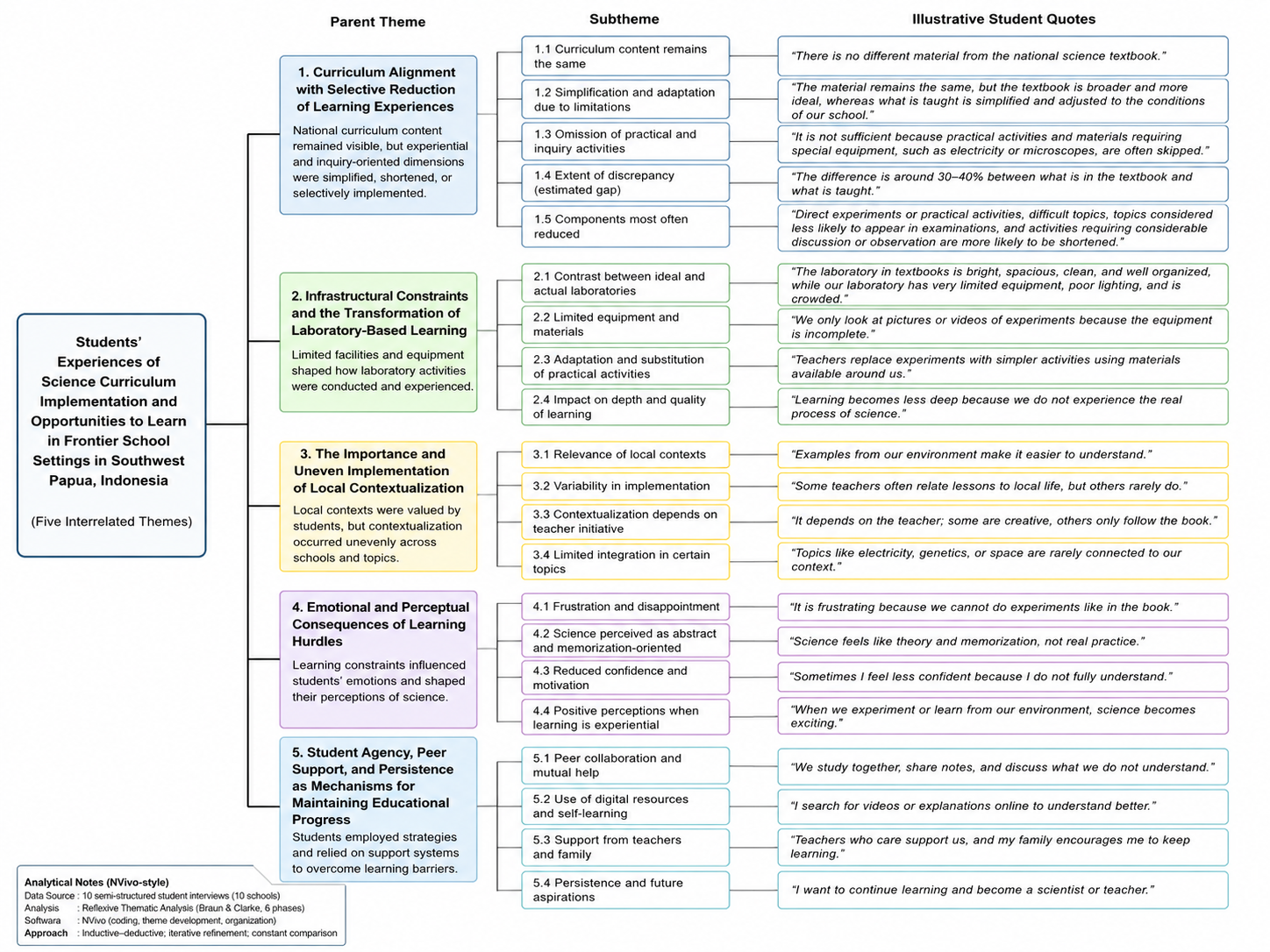
Equitable access to quality science education remains a critical global challenge, as standardized curricular reforms frequently encounter structural inequalities in geographically remote areas. Using a qualitative descriptive design informed by reflexive thematic analysis, this study examined how junior secondary students in a frontier (3T) setting in Southwest Papua Province, Indonesia, experienced discrepancies between national science curriculum expectations and their actual classroom learning opportunities, and how they responded to learning hurdles in science. Data were gathered from 10 students convenience sampled from 10 different schools through semi structured individual interviews organized around two domains, include students' experiences of curriculum–practice discrepancies, and learning hurdles and students' negotiation strategies. Regarding the first research question, students reported that topics prescribed by the national curriculum generally remained visible in classroom instruction, but that laboratory based, inquiry oriented, and locally contextualized learning opportunities were considerably reduced by resource limitations, out of field teaching, and geographic isolation. Regarding the second research question, the analysis indicated that learning hurdles had a double edged effect include constraints were associated with frustration and a view of science as abstract and memorization oriented, yet, when successfully negotiated through peer collaboration, digital resources, and local ecological knowledge, the same constraints could also support creativity and a more situated understanding of science. These findings suggest that standardized curriculum implementation does not by itself guarantee equitable opportunities to learn, pointing to a need for sensitive context, differentiated implementation support in frontier schools. As the study draws on a small, geographically bounded sample from Southwest Papua, the findings should be read as an in depth, contextually grounded account rather than a statistically generalizable one, future research could extend this work through classroom observation, teacher perspectives, and comparative frontier–urban designs.
References
Ala, C. C., & Antonio, R. P. (2026). Collaborate to Learn: A Scoping Review of Peer Tutoring Strategies in Secondary Science Education. International Journal of Research in Education and Science, 12(2), 275–299. https://doi.org/https://doi.org/10.46328/ijres.5534
Amiri, A., & Rezvani, R. (2021). A Tale of Three Official English Textbooks: An Evaluation ofTheir Horizontal and Vertical Alignments. Scientific Information Database, 12(3). https://doi.org/https://doi.org/10.29252/LRR.12.3.3
Amponsah, D. K., & Mohammed, M. S. (2019). Perception of learning science: the case of females offering STEM majors in Ghana. African Journal of Educational Studies in Mathematics and Sciences, 15(2), 141–154. https://doi.org/https://doi.org/10.4314/ajesms.v15i2.12
Ananda, T., Ayub, D., & Irawan, D. (2025). Development of Inclusive Learning Based on Problem-Based Learning to Improve Critical Thinking Skills and Scientific Attitudes of Students in the 3T Areas of Riau Province. Jurnal Penelitian Pendidikan IPA, 11(11), 79–85. https://doi.org/10.29303/jppipa.v11i11.12830
Archer, L., DeWitt, J., Osborne, J., Dillon, J., Willis, B., & Wong, B. (2010). “Doing” science versus “being” a scientist: Examining 10/11‐year‐old schoolchildren’s constructions of science through the lens of identity. Science Education, 94(4), 617–639. https://doi.org/https://doi.org/10.1002/sce.20399
Assaf, N. F. (2023). Impact of the Rigorous Curriculum Design for Project-Based Learning Implementation on Middle School Students ’ Science Achievement and MAP Progress. 12(6), 139–165. https://doi.org/10.5539/jel.v12n6p139
Baharuddin, & Burhan. (2025). Urban and rural teacher perspectives on Indonesian educational reform: Challenges and policy implications. Cogent Education, 12(1), 2497142. https://doi.org/https://doi.org/10.1080/2331186x.2025.2497142
Baidoo-Anu, D., & Mensah, G. E. (2018). The perceptions of junior high school students and teachers towards teaching and learning of integrated science at Komenda-Edina-Eguafo-Abrim district. Asian Journal of Education and Social Studies, 2(2), 1–8. https://doi.org/https://doi.org/10.9734/ajess/2018/40173
Beyessa, F. (2023). Students ’ voice and power accountability relationship for curriculum implementation in Ethiopian primary schools : A qualitative study Students ’ voice and power accountability relationship for curriculum implementation in Ethiopian primary schools : A qualitative study. Cogent Education, 10(2). https://doi.org/10.1080/2331186X.2023.2252081
Botes, W., & Blennis, F. (2025). The role of improvised teaching materials in the teaching of human reproduction in grade 12 life sciences. Education. Innovation. Diversity, 1(10), 36–49. https://doi.org/https://doi.org/10.17770/eid2025.1.8369
Braun, V., & Clarke, V. (2021). To saturate or not to saturate? Questioning data saturation as a useful concept for thematic analysis and sample-size rationales. Qualitative Research in Sport, Exercise and Health, 13(2), 201–216. https://doi.org/https://doi.org/10.1080/2159676x.2019.1704846
Braun, V., Clarke, V., Boulton, E., Davey, L., & McEvoy, C. (2021). The online survey as a qualitative research tool. International Journal of Social Research Methodology, 24(6), 641–654. https://doi.org/https://doi.org/10.1556/063.2021.00041
Chang, C.-W., Cheng, S.-S., Chang, I.-W., Liaw, F.-R., & Cheng, C.-C. (2021). The development of “early childhood education & care curriculum framework implementation scale” in Taiwan. Hungarian Educational Research Journal, 11(4), 377–395. https://doi.org/https://doi.org/10.1080/09500693.2020.1817607
Chen, S., Jamiatul Husnaini, S., & Chen, J.-J. (2020). Effects of games on students’ emotions of learning science and achievement in chemistry. International Journal of Science Education, 42(13), 2224–2245.
Chetcuti, D. A., & Kioko, B. (2012). Girls’ attitudes towards science in Kenya. International Journal of Science Education, 34(10), 1571–1589. https://doi.org/https://doi.org/10.1080/09500693.2012.665196
Clemmons, A. W., Donovan, D. A., Theobald, E. J., & Crowe, A. J. (2022). Using the intended–enacted–experienced curriculum model to map the vision and change core competencies in undergraduate biology programs and courses. CBE—Life Sciences Education, 21(1), ar6. https://doi.org/https://doi.org/10.1187/cbe.21-02-0054
Coffie, I. S., Frempong, B. B., Taylor, I., & Appiah, E. (2026). What matters to students in the teaching and learning of science: Perspectives of junior high school students from Ghana. Research in Science Education, 56(2), 655–671. https://doi.org/https://doi.org/10.1007/s11165-025-10290-w
Denton, M., & Borrego, M. (2021). Funds of knowledge in STEM education: A scoping review. Studies in Engineering Education, 1(2). https://doi.org/https://doi.org/10.21061/see.19
Dhurumraj, T., & Moola, Z. (2023). Exploring teacher improvisation and its influence on learner performance in an under-resourced Grade 11 Life Science class. International Journal of Research in Business and Social Science (2147-4478), 12(2), 384–392. https://doi.org/https://doi.org/10.20525/ijrbs.v12i2.2341
Doyle, W., & Rosemartin, D. (2012). The ecology of Curriculum Enactment. In Interpersonal relationships in education: An overview of contemporary research (pp. 137–147). Springer. https://doi.org/https://doi.org/10.1007/978-94-6091-939-8_9
Farihen, F., Nuh, A., Fakhrurazi, F., & Misbakul, M. (2026). Curriculum as Compliance , Not Competence : Epistemic Fragmentation in Indonesia ’ s Underserved Schools. Journal of Curriculum Studies Research, 8(2), 1–24. https://doi.org/https://doi.org/10.46303/jcsr.2026.22
Fasasi, R. A. (2017). Effects of ethnoscience instruction, school location, and parental educational status on learners’ attitude towards science. International Journal of Science Education, 39(5), 548–564. https://doi.org/https://doi.org/10.1080/09500693.2017.1296599
Fitri, R. M., Jupri, A., Mulyaning, E. C., & Sitanggang, D. A. (2025). Technology Integration in Problem-Based Culturally Responsive Mathematics Learning: A Systematic Literature Review in the Era of Industry 5.0. Jurnal Absis: Jurnal Pendidikan Matematika Dan Matematika, 8(1), 205–219. https://doi.org/https://doi.org/10.30606/absis.v8i1.3340
Godec, S., King, H., & Archer, L. (2017). The science capital teaching approach: Engaging students with science, promoting social justice. University College London. www.ucl.ac.uk/ioe-sciencecapital
Gunawan, W., Kurniawan, E., & Hakim, M. A. (2025). Navigating inconsistencies: The challenges of implementing multilingual education policy in rural Indonesia. Social Sciences & Humanities Open, 11, 101601. https://doi.org/https://doi.org/10.1016/j.ssaho.2025.101601
Habibi, A., Mukminin, A., & Hadisaputra, P. (2020). Science teachers’ integration of digital resources in education: A survey in rural areas of one Indonesian province. Heliyon, 6(8). https://doi.org/https://doi.org/10.1016/j.heliyon.2020.e04631
Harefa, E. (2024). Predicting Science Learning Outcomes Of Elementary Students In Rural Area Using Machine Learning Algorithms. INNOVATIVE: Journal Of Social Science Research, 4(1), 3780–3792. https://doi.org/https://doi.org/10.31004/innovative.v4i6.16655
Hodson, D. (2003). Time for action: Science education for an alternative future. International Journal of Science Education, 25(6), 645–670. https://doi.org/10.1080/09500690305021
Ibe, E., & Nwosu, A. A. (2017). Effects of ethnoscience and traditional laboratory practical on science process skills acquisition of secondary school biology students in Nigeria. British Journal of Multidisciplinary and Advanced Studies, 1(1), 35–46. https://bjmas.org/index.php/bjmas
Inouye, K., Lee, S., & Oldac, Y. I. (2023). A systematic review of student agency in international higher education. Higher Education, 86(4), 891–911. https://doi.org/https://doi.org/10.1007/s10734-022-00952-3
Irayanti, I. (2026). Teachers’ readiness and pedagogical change in curriculum reform: why dialogic and critical pedagogy fail to take root in Indonesia primary schools. Asian Education and Development Studies, 1–22. https://doi.org/https://doi.org/10.1108/aeds-11-2025-0593
Iturbe-Sarunic, C., Miller, B. G., & Merino, C. (2025). Advancing rural science education in Chile through local rural knowledge: a design-based approach to water education. Frontiers in Education, 10, 1537891. https://doi.org/https://doi.org/10.3389/feduc.2025.1537891
Kasi, Y. F., Samsudin, A., & Widodo, A. (2021). A Thematic Review on Exploring Ethnoscience in Science Education : A Case in Indonesia. 6(2), 229–241. https://doi.org/10.24042/tadris.v6i2.9509
Khan, S., Hwang, G., Azeem Abbas, M., & Rehman, A. (2019). Mitigating the urban–rural educational gap in developing countries through mobile technology‐supported learning. British Journal of Educational Technology, 50(2), 735–749. https://doi.org/https://doi.org/10.1111/bjet.12692
Kirk, M., Ferguson, J. P., & Ferguson, J. P. (2025). REAL possibilities : innovative and responsive curriculum enactment enabling impactful inquiry in primary science. International Journal of Science Education, 0693, 2156–2179. https://doi.org/10.1080/09500693.2024.2382388
Kizilcec, R. F., Chen, M., Jasińska, K. K., Madaio, M., & Ogan, A. (2021). Mobile learning during school disruptions in sub-Saharan Africa. AERA Open, 7, 23328584211014860. https://doi.org/https://doi.org/10.1177/23328584211014860
Lawer Egbenya, D., & Kwesi Quayson, E. (2022). Attitude of junior high school students towards the study of science in Ghanaian schools: the case of first-year students in the Cape Coast metropolis. International Journal of Science Education, 44(16), 2442–2464. https://doi.org/https://doi.org/10.1080/09500693.2022.2126954
Lesnefsky, R. R., Sadler, T. D., & Fortus, D. (2025). Implementing grand challenges: A case study of implementing innovative curricula. Research in Science Education, 55(4), 743–769. https://doi.org/https://doi.org/10.1007/s11165-024-10228-8
Li, L., Huang, C.-W., Morgan, C., Luttgen, K., Chow, E., & Yang, S. (2025). Empowering rural students through computational thinking and real-world STEM applications: insights from an innovative high school curriculum. Frontiers in Education, 9, 1452470. https://doi.org/https://doi.org/10.3389/feduc.2024.1452470
Mabasa, T., & Singh, S. (2020). Decolonising continuing teacher professional development in the teaching of physical science through improvisation in rural areas. South African Journal of Higher Education, 34(3), 146–163. https://doi.org/https://doi.org/10.20853/34-3-3455
Makori, H. K., Morales, C. J., & Bayer, I. S. (2025). The role of habitus, structure, and agency in the implementation of Science reform practices. Science Education, 109(4), 1129–1146. https://doi.org/https://doi.org/10.1002/sce.21973
Matthews, K. E., & Mercer-Mapstone, L. D. (2018). Toward curriculum convergence for graduate learning outcomes: academic intentions and student experiences. Studies in Higher Education, 43(4), 644–659. https://doi.org/https://doi.org/10.1080/03075079.2016.1190704
McCrory, G., Holmén, J., Holmberg, J., & Adawi, T. (2021). Learning to frame complex sustainability challenges in place: Explorations into a transdisciplinary “challenge lab” curriculum. Frontiers in Sustainability, 2, 714193. https://doi.org/https://doi.org/10.3389/frsus.2021.714193
Millar, V. (2020). Trends, Issues and Possibilities for an Interdisciplinary STEM Curriculum. Science & Education, 29(4), 929–948. https://doi.org/https://doi.org/10.1007/s11191-020-00144-4
Mitra, D. (2018). Student voice in secondary schools: The possibility for deeper change. Journal of Educational Administration, 56(5), 473–487. https://doi.org/https://doi.org/10.1108/jea-01-2018-0007
Moll, L. C. (2019). Elaborating funds of knowledge: Community-oriented practices in international contexts. Literacy Research: Theory, Method, and Practice, 68(1), 130–138. https://doi.org/https://doi.org/10.1177/2381336919870805
Moula, A., & Guermat, E. (2026). Investigating Student Empowerment and Social Involvement : The Case of a Moroccan University. Ucation for Schol Rs (JOTES) Journal of Teaching and Education for Scholars, 17–30. https://doi.org/https://doi.org/10.59065/jotes.v3i1.248
Nguyen, N. M. (2026). Meaningful Platforms for Student Voice in Vietnamese Schools : The Role of Student Media and School Communication. International Journal of Social Science and Humanities Research, 9(July), 84–94. https://doi.org/https://doi.org/10.5281/zenodo.21944434
Niemi, H., & Mclean, D. (2026). Towards Industrial Revolution and Sustainable Growth in Africa (H. Niemi, D. McLean, M. Vivitsou, & J. Lavonen (eds.)). Springer International Publishing. https://doi.org/https://doi.org/10.1007/978-981-92-1935-3
Nugraha, R., & Bajari, A. (2022). Strategies for Increasing Access and Quality of Education at the Elementary School Levels in Papua and West Papua Province. International Academic Journal of Education and Literature, 3(2), 1–4. https://doi.org/https://doi.org/10.47310/iarjel.2022.v03i01.015
OECD. (2018). Future of Education and Skills 2030 : Curriculum Analysis. Organisation for Economic Co-Operation and Development For, 46(November).
Parmin, P., & Taufiq, M. (2020). The Mapping of Indigenous Knowledge of People at 3T (Frontier, Outermost, and Least Developed) Regions as an Ethnoscience Study. Tadris: Jurnal Keguruan Dan Ilmu Tarbiyah, 5(1), 1–10. https://doi.org/https://doi.org/10.24042/tadris.v5i1.6168
Pepin, B. (2021). Connectivity in support of student co-design of innovative mathematics curriculum trajectories. ZDM – Mathematics Education, 53(6), 1221–1232. https://doi.org/https://doi.org/10.1007/s11858-021-01297-4
Perry, L. B., Thier, M., Beach, P., Anderson, R. C., Thoennessen, N.-M., & Roberts, P. (2024). Opportunities and conditions to learn (OCL): A conceptual framework. Prospects, 54(1), 55–72. https://doi.org/https://doi.org/10.1007/s11125-023-09637-w
Reichert, F., Zhang, J., Law, N. W. Y., Wong, G. K. W., & Torre, J. De. (2022). Exploring the structure of digital literacy competence assessed using authentic software applications. Educational Technology Research and Development, 2020, 2991–3013. https://doi.org/10.1007/s11423-020-09825-x
Remillard, J. T. (2005). Examining key concepts in research on teachers’ use of mathematics curricula. Review of Educational Research, 75(2), 211–246. https://doi.org/https://doi.org/10.3102/00346543075002211
Rezvani, R., & Farsimadan, D. (2025). The alignment of intended, enacted, and assessed curricula: The case of Shiraz university TEFL BA curriculum. Applied Research on English Language, 14(1), 1–28. https://doi.org/10.22108/are.2024.142877.2373
Rosmana, P. S., Iskandar, S., Fadilah, N., Azhar, N., Oktavini, D., & Munte, A. C. (2022). Upaya pemerataan pendidikan berkelanjutan di daerah 3T. ATTADIB, 6(2), 405–418. https://www.jurnalfai-uikabogor.org/attadib
Sudarmin, S., Selia, E., & Taufiq, M. (2018). The influence of inquiry learning model on additives theme with ethnoscience content to cultural awareness of students. Journal of Physics: Conference Series, 983(1), 12170. https://doi.org/https://doi.org/10.1088/1742-6596/983/1/012170
Suprapto, N., Prahani, B. K., & Cheng, T. H. (2021). Indonesian curriculum reform in policy and local wisdom: Perspectives from science education. Jurnal Pendidikan IPA Indonesia, 10(1), 69–80. https://doi.org/https://doi.org/10.15294/jpii.v10i1.28438
Sutomo, M., & Siregar, E. S. (2022). Teacher professional development in Indonesia’s remote areas with driven educational philanthropic institutions. Jurnal Penelitian Dan Pengembangan Pendidikan, 6(3), 500–509. https://doi.org/https://doi.org/10.23887/jppp.v6i3.55742
Suwono, H., Rizkita, M. A., Prasetyo, S. D., & Chang, C. (2026). Bridging cultures and science : Enhancing scientific literacy through local wisdom-based citizen science in Indonesia ’ s 3T regions. International Journal on Math Science and Technology Education, 14(3), 1–33. https://doi.org/https://doi.org/10.31129/LUMAT.14.3.3030
Thijs, A., & Van Den Akker, J. (2009). Curriculum in development. Netherlands Institute for Curriculum Development (SLO).
Thompson, D. R., & Usiskin, Z. (2013). Enacted mathematics curriculum: A conceptual framework and research needs. IAP.
Tran, L. T., Jung, J., Unangst, L., & Marshall, S. (2023). New developments in internationalisation of higher education. In Higher Education Research & Development (Vol. 42, Issue 5, pp. 1033–1041). Taylor & Francis. https://doi.org/https://doi.org/10.1080/07294360.2023.2216062
Treacy, M., Leavy, A., & Treacy, M. (2023). Professional Development in Education Student voice and its role in creating cognitive dissonance : the neglected narrative in teacher professional development neglected narrative in teacher professional development. Professional Development in Education, 49(3), 458–477. https://doi.org/10.1080/19415257.2021.1876147
Tripp, J. N., & Waight, N. (2024). Co‐creating a community of belonging and presence: Multilingual learners’ experiences of science and language learning at an urban, inclusive STEM‐focused high school. Science Education, 108(1), 25–62. https://doi.org/https://doi.org/10.1002/sce.21827
Tutal, Ö. (2026). Enacting the curriculum: The interplay of pedagogical beliefs, motivation, and fidelity. Plos One, 21(5), e0349102. https://doi.org/https://doi.org/10.1371/journal.pone.0349102
Uno, W. A., & Karim, F. (2025). Title Regulatory Strategy for Utilizing Augmented Reality as a Visual Aid in Science Learning in Rural Elementary Schools. Jurnal Teknologi Pendidikan, 27(2), 741–750. https://doi.org/https://doi.org/10.21009/jtp.v27i2.58059
Van den Akker, J. (2003). Curriculum perspectives: An introduction. In Curriculum landscapes and trends (pp. 1–10). Springer. https://doi.org/https://doi.org/10.1007/978-94-017-1205-7_1
Zhai, Y., Tripp, J., & Liu, X. (2024). Science teacher identity research: A scoping literature review. International Journal of STEM Education, 11(1), 20. https://doi.org/https://doi.org/10.1186/s40594-024-00481-8
Downloads
Published
How to Cite
Issue
Section
License
Copyright (c) 2026 Rabiudin Rabiudin, Agus Salim, Gladys Mahaut, Arhan Keliata, Nurani Rahareng

This work is licensed under a Creative Commons Attribution 4.0 International License.