The Role of Digital Literacy in Strengthening the Pedagogical Competence of Elementary School Physical Education Teachers in Gorontalo City
DOI:
https://doi.org/10.47945/misool.v8i1.3317Keywords:
Digital Literacy, Pedagogical Competence, Physical Education TeachersAbstract
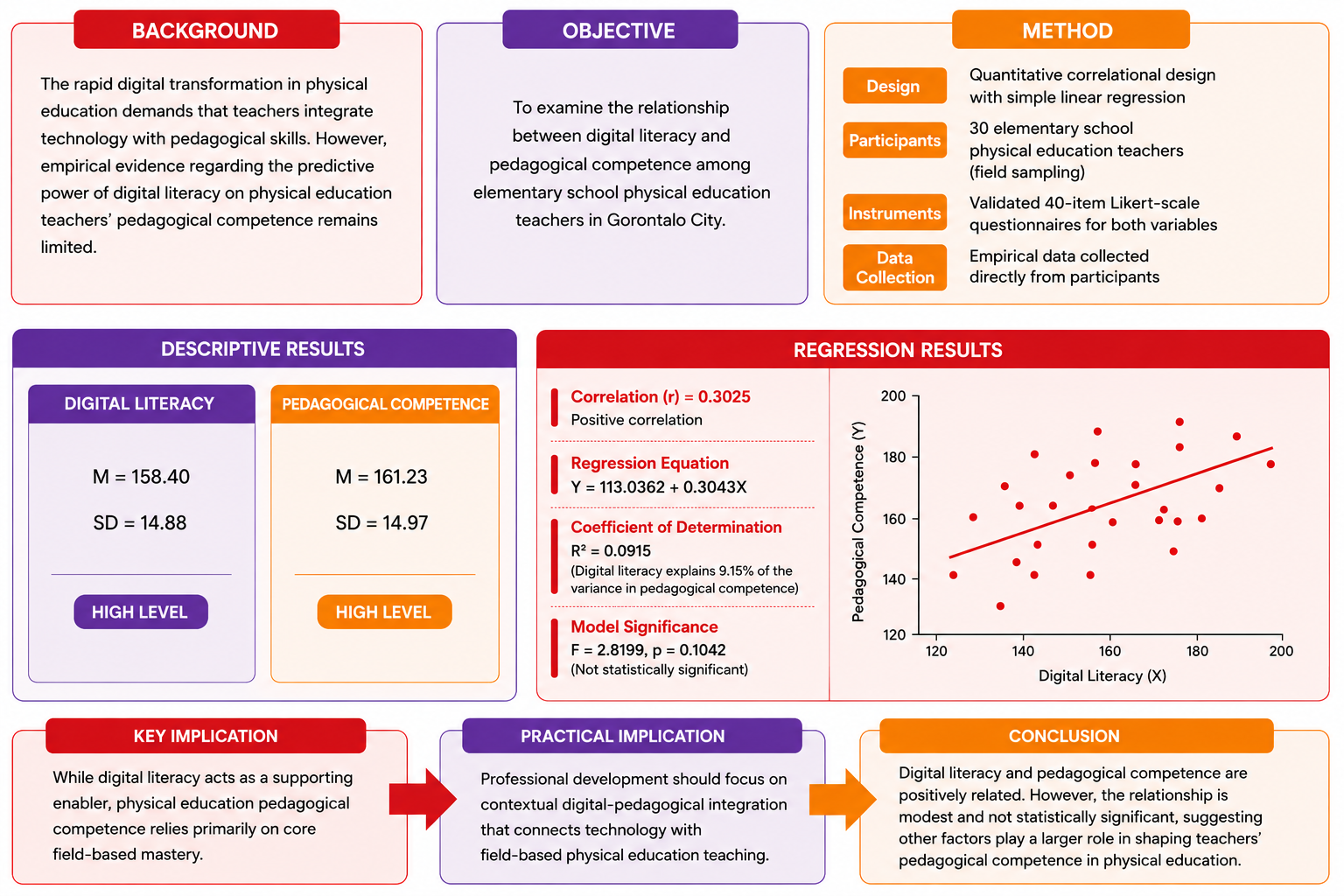
The rapid digital transformation in physical education demands that teachers integrate technology with pedagogical skills. However, empirical evidence regarding the predictive power of digital literacy on physical education teachers' pedagogical competence remains limited. This study aims to examine the relationship between digital literacy and pedagogical competence among elementary school physical education teachers in Gorontalo City. A quantitative correlational design with simple linear regression was employed, involving 30 field-sampled elementary physical education teachers. Empirical data were collected directly using validated 40-item Likert-scale questionnaires for both variables. Descriptive results indicated high average levels of digital literacy (M = 158.40, SD = 14.88) and pedagogical competence (M = 161.23, SD = 14.97). Simple linear regression revealed a positive correlation (r = 0.3025) and a linear equation of Y = 113.0362 + 0.3043X, with digital literacy accounting for 9.15% (R² = 0.0915) of the variance in pedagogical competence, although not statistically significant (F = 2.8199, p = 0.1042). These empirical findings imply that while digital literacy acts as a supporting enabler, physical education pedagogical competence relies primarily on core field-based mastery. Professional development should focus on contextual digital-pedagogical integration.
References
Afifudin, A., & Asep Sahrul Gunawan. (2026). Analisis Literatur tentang Peran Teknologi Interactive Flat Panel dalam Transformasi Pembelajaran Pendidikan Jasmani Olahraga dan Kesehatan di Sekolah Menengah Pertama. Jumper: Jurnal Mahasiswa Pendidikan Olahraga, 7(1), 74–85. https://doi.org/10.55081/jumper.v7i1.5656
Al-Ghurabli, B., Al-Smadi, M., & Ababneh, A. (2024). Digital literacy and self-efficacy as predictors of technology integration among physical education teachers. Journal of Physical Education and Sport, 24(2), 415–424. https://doi.org/10.7752/jpes.2024.02051
Bangsbo, J., Hansen, P. R., & Krustrup, P. (2025). Artificial intelligence and digital video analysis in physical education: Enhancing pedagogical feedback in movement assessment. European Physical Education Review, 31(1), 88–104. https://doi.org/10.1177/1356336X241258901
Bodsworth, H., & Goodyear, V. A. (2020). Barriers and enablers to teachers’ use of technology in physical education: A systematic review. European Physical Education Review, 26(4), 901–918. https://doi.org/10.1177/1356336X20904076
Chen, H., & Zhang, Y. (2025). Bridging the gap between digital literacy and pedagogical integration in primary physical education: A mixed-methods study. Computers & Education, 226, 105210. https://doi.org/10.1016/j.compedu.2024.105210
Goodyear, V. A., & Armour, K. M. (2019). Young People, Social Media and Health. Routledge. https://doi.org/10.4324/9781351026987
Ha, T., Dauenhauer, B., Krause, J., McMullen, J., & Farber, M. (2025). Comprehensive school physical activity program technology practice questionnaire (CSPAP-TPQ). Educational Technology Research and Development, 73(1), 283–300. https://doi.org/10.1007/s11423-024-10399-1
Hamzah, A., & Ramadhansyah, M. N. (2026). Perubahan Perilaku Olahraga di Era Digital antara Kemudahan Akses dan Risiko Sedentari. Jurnal Inovasi Olahraga, 5(01), 64–71.
Hasmyati, H., & Aksir, Muh. I. (2026). Transformasi Digital dalam Olahraga: Implikasi terhadap Partisipasi, Performa, dan Kesehatan. Jurnal Penelitian, Pengembangan, Pembelajaran & Teknologi (JP3T), 4(2), 144–154.
Istiyono, E., Mustafa, P. S., & Wandik, Y. (2024). Assessing TPACK framework implementation among primary school physical education teachers: A structural equation modeling approach. International Journal of Human Movement and Sports Sciences, 12(3), 512–522. https://doi.org/10.13189/saj.2024.120308
Kombong, Y. (2026). “PENDIDIKAN JASMANI DI ERA DIGITAL.” Revolusi Digital Dalam Pendidikan Jasmani: Ancaman Atau Peluang?
Martínez-Baena, A. C., Mayorga-Vega, D., & Viciana, J. (2024). Physical education teachers’ digital competence and its influence on students’ physical activity levels: A cross-sectional study. Journal of Teaching in Physical Education, 43(2), 285–294. https://doi.org/10.1123/jtpe.2023-0112
McFadden, C. (2021). Wearable Exercise Technology and the Impact on College Women’s Physical Activity. Quest, 73(2), 179–191. https://doi.org/10.1080/00336297.2021.1891553
Musridho, R. J., Priyatno, A. M., & Ramadhan, W. F. (2024). Penggunaan Aplikasi Pendeteksi Olahraga berbasis Global Positioning System (GPS) untuk Meningkatkan Aktivitas Fisik Masyarakat. Journal of Social and Community Service, 3(3), 168–170. https://doi.org/10.31004/jestmc.v3i3.200
Pradana, A. P., & Winarno, M. E. (2025). Studi Deskriptif Tingkat Aktivitas Fisik Siswa Kelas XI Madrasah Aliyah di Era Teknologi Digital. JURNAL PENDIDIKAN OLAHRAGA, 15(6), 510–516. https://doi.org/10.37630/jpo.v15i6.3759
Ribeiro, J., Silva, R., & Martins, F. (2024). Wearable technology and digital assessment tools in physical education: Pedagogical opportunities and implementation challenges. Physical Education and Sport Pedagogy, 29(4), 412–428. https://doi.org/10.1080/17408989.2023.2215489
Santos, R., Ferreira, M., & Campos, P. (2025). Continuous professional development in digital technologies for physical education teachers: Impact on instructional self-efficacy. Teaching and Teacher Education, 141, 104520. https://doi.org/10.1016/j.tate.2024.104520
Schmidt, D. A., Baran, E., Thompson, A. D., Mishra, P., Koehler, M. J., & Shin, T. S. (2009). Technological Pedagogical Content Knowledge (TPACK). Journal of Research on Technology in Education, 42(2), 123–149. https://doi.org/10.1080/15391523.2009.10782544
Septiyaningtiyas, H. D., Handhayani, S., Winata, B. P., & Setiadi, H. W. (2025). Integrasi Interaktif Flat Panel Dan Smart TV Dalam Penggunaan Platform Interaktif (Wordwall, Liveworksheets, Kahoot) Dalam Pengembangan Bahan Ajar Digital Untuk Meningkatkan Partisipasi Belajar Siswa. Jurnal IKA PGSD (Ikatan Alumni PGSD) UNARS, 16(2), 254. https://doi.org/10.36841/pgsdunars.v16i2.7524
Sutarto. (2020). Pendidikan jasmani dan kesehatan. PT RajaGrafindo Persada.
Tung, C. H., Lin, Y. C., & Chen, C. N. (2025). Examining the impact of digital competence on physical education teachers’ instructional design and student engagement. Computers & Education, 224, 105150. https://doi.org/10.1016/j.compedu.2024.105150
Wahyono, M., Putra, I. B., Utomo, G. M., & Kusuma, A. I. (2025). Integrasi Teknologi Wearable Fitness Tracker pada Pembelajaran Pendidikan Jasmani dalam Meningkatkan Keaktifan dan Kebugaran Siswa. Jurnal Pendidikan Kesehatan Rekreasi, 11(1), 67–75. https://doi.org/10.59672/jpkr.v11i1.4238
Wang, L., & Tan, K. (2025). Integrating smart wearable technology into physical education: Teachers’ pedagogical adaptation and digital literacy challenges. Physical Education and Sport Pedagogy, 30(2), 175–191. https://doi.org/10.1080/17408989.2024.2345678
Wiarto, G. (2023). Teknologi dalam olahraga. CV Tidar Media.
Yang, X., & Hu, J. (2024). The relationship between physical education teachers’ digital skills, pedagogical competence, and school support in primary education. Teaching and Teacher Education, 139, 104445. https://doi.org/10.1016/j.tate.2023.104445
Downloads
Published
How to Cite
Issue
Section
License
Copyright (c) 2026 Muhammad Faisal Lutfi Amri, Nur Sakinah Aries

This work is licensed under a Creative Commons Attribution 4.0 International License.