Digital Technology Integration in Akidah Akhlak Learning: A Descriptive Study of Classroom Assessment and Participation in Grade 5 at MI Al-Ishlah, Sorong City
DOI:
https://doi.org/10.47945/misool.v8i1.3343Keywords:
Classroom Participation, Classroom Study, Digital Learning Media, Islamic Moral Education, Primary EducationAbstract
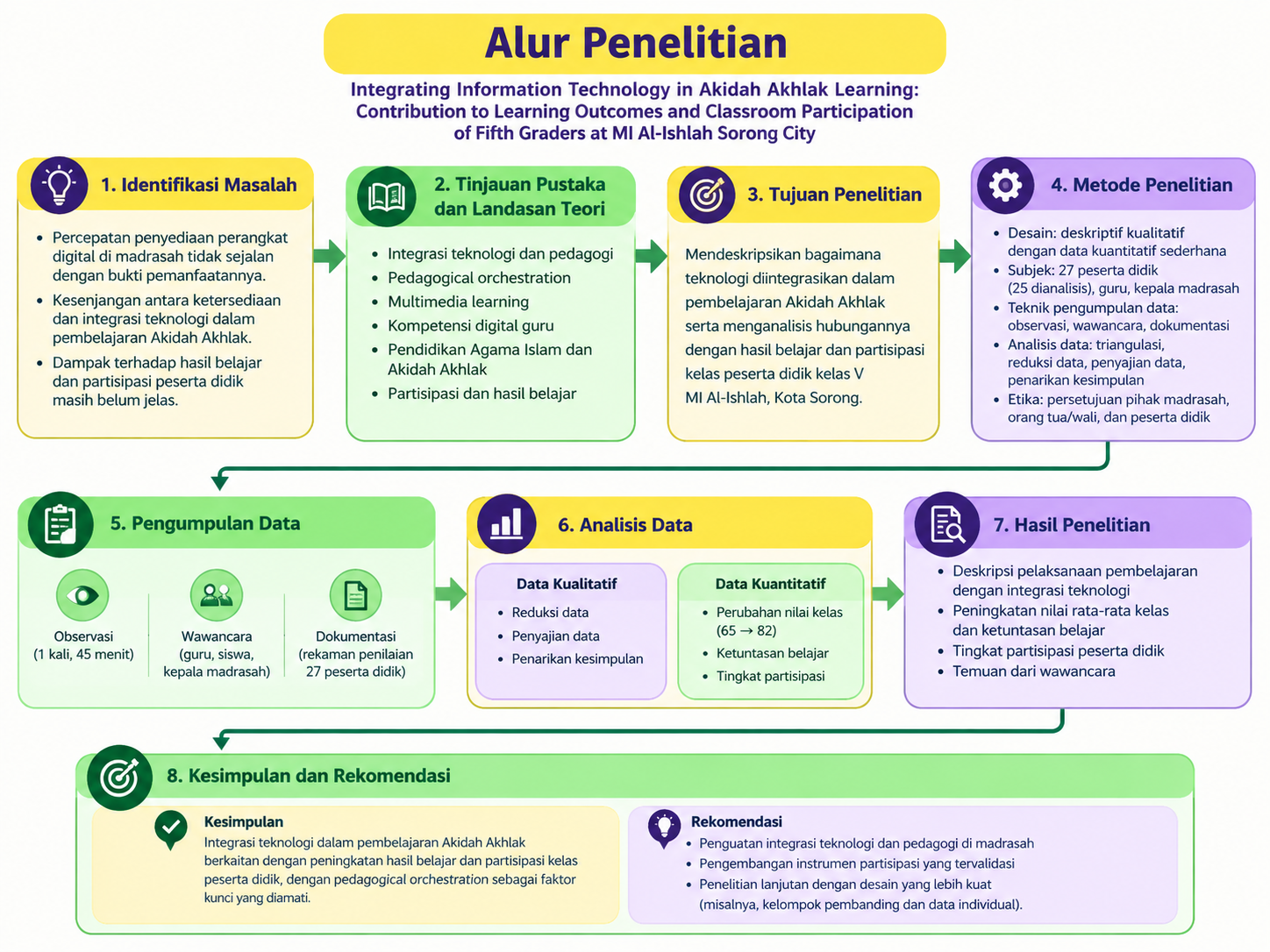
Digital devices have spread across Indonesian madrasah faster than evidence on how they are used in Islamic moral education. This descriptive study documents how digital technology was integrated into one Akidah Akhlak lesson and reports the accompanying class-level assessment records and observed participation in Grade 5 at MI Al-Ishlah, Sorong City, Southwest Papua. Data comprised structured observation of a 45-minute lesson on 23 May 2026, interviews with the teacher and the head of the madrasah, group interviews with students, and documentation of assessment records. The class enrolled 27 students; complete assessment records at both time points and full observational coverage were available for 25, who constitute the analysis group. The teacher combined a laptop, a projector, and a smart TV with demonstration, small-group discussion, and presentation. The class mean was 65 before and 82 after the lesson, and students meeting the mastery criterion numbered 12 (48%) and 22 (88%) of 25. Among the 25 observed students, 20 (80%) were classified as active, 3 (12%) moderately active, and 2 (8%) less active. Because the design has no comparison group, no randomisation, and no individual-level data, results are reported as descriptive patterns in a single classroom rather than as effects of technology.
References
Ardyanti, Y., Bahari, M. F. Y., Helmawati, Suryadi, I., & Huda, M. (2025). The impact of technology integration in Islamic religious education on students’ learning motivation in schools/madrasahs in Bandung. Belajea: Jurnal Pendidikan Islam, 10(2), 421–440. https://doi.org/10.29240/belajea.v10i2.13406
Asmawati, F., & Sholihah, D. A. (2024). Upaya peningkatan ketuntasan hasil belajar matematika siswa kelas V MIN 2 Kulon Progo dengan menggunakan media video pembelajaran. Indonesian Journal of Elementary Education and Teaching Innovation, 3(2), 100–108. https://doi.org/10.21927/ijeeti.2024.3(2).100-108
Chauhan, S. (2017). A meta-analysis of the impact of technology on learning effectiveness of elementary students. Computers & Education, 105, 14–30. https://doi.org/10.1016/j.compedu.2016.11.005
Chen, J., Wang, M., Kirschner, P. A., & Tsai, C.-C. (2018). The role of collaboration, computer use, learning environments, and supporting strategies in CSCL: A meta-analysis. Review of Educational Research, 88(6), 799–843. https://doi.org/10.3102/0034654318791584
Creswell, J. W., & Poth, C. N. (2018). Qualitative inquiry and research design: Choosing among five approaches (4th ed.). SAGE Publications.
Ekawati, S. (2024). Pengembangan media pembelajaran IPAS berbasis permainan ular tangga pada materi energi di kelas IV SD Annur Yapis Kota Sorong. MISOOL: Jurnal Pendidikan Dasar, 6(2), 94–102. https://doi.org/10.47945/misool.v6i2.1802
Habibi, A., Mukminin, A., & Hadisaputra, P. (2020). Science teachers’ integration of digital resources in education: A survey in rural areas of one Indonesian province. Heliyon, 6(8), Article e04631. https://doi.org/10.1016/j.heliyon.2020.e04631
Huda, M., Arif, M., Rahim, M. M. A., & Anshari, M. (2024). Islamic religious education learning media in the technology era: A systematic literature review. At-Tadzkir: Islamic Education Journal, 3(2), 83–103. https://doi.org/10.59373/attadzkir.v3i2.62
Kartini, K. S., & Putra, I. N. T. A. (2020). Pengaruh penggunaan media pembelajaran interaktif berbasis Android terhadap hasil belajar siswa. Jurnal Redoks: Jurnal Pendidikan Kimia dan Ilmu Kimia, 3(2), 8–12. https://doi.org/10.33627/re.v3i2.417
Kates, A. W., Wu, H., & Coryn, C. L. S. (2018). The effects of mobile phone use on academic performance: A meta-analysis. Computers & Education, 127, 107–112. https://doi.org/10.1016/j.compedu.2018.08.012
Kementerian Agama Republik Indonesia. (2019). Keputusan Menteri Agama Republik Indonesia Nomor 183 Tahun 2019 tentang Kurikulum Pendidikan Agama Islam dan Bahasa Arab pada Madrasah. Kementerian Agama Republik Indonesia.
Kharismatunisa, I. (2023). Innovation and creativity of Islamic religious education teachers in utilizing digital-based learning media. Scaffolding: Jurnal Pendidikan Islam dan Multikulturalisme, 5(3), 519–538. https://doi.org/10.37680/scaffolding.v5i3.3700
Kirschner, P. A., & De Bruyckere, P. (2017). The myths of the digital native and the multitasker. Teaching and Teacher Education, 67, 135–142. https://doi.org/10.1016/j.tate.2017.06.001
Lai, J. W. M., & Bower, M. (2019). How is the use of technology in education evaluated? A systematic review. Computers & Education, 133, 27–42. https://doi.org/10.1016/j.compedu.2019.01.010
Mayer, R. E. (2021). Multimedia learning (3rd ed.). Cambridge University Press.
Miles, M. B., Huberman, A. M., & Saldaña, J. (2019). Qualitative data analysis: A methods sourcebook (4th ed.). SAGE Publications.
Mintasih, D., Sukiman, S., & Purnama, S. (2024). Integration of digital technology in Islamic religious education learning: A qualitative study on teachers’ competence and implementation models in secondary schools. Jurnal Pendidikan Islam, 13(1), 85–96. https://doi.org/10.14421/jpi.2024.131.85-96
Mishra, P., & Koehler, M. J. (2006). Technological pedagogical content knowledge: A framework for teacher knowledge. Teachers College Record, 108(6), 1017–1054. https://doi.org/10.1177/016146810610800610
Muslim, M. (2024). Internalising digital technology in Islamic education. Scaffolding: Jurnal Pendidikan Islam dan Multikulturalisme, 6(3), 180–197. https://doi.org/10.37680/scaffolding.v6i3.6309
Okta Nadia, D., & Desyandri, D. (2022). Pengaruh media pembelajaran Wordwall terhadap hasil belajar siswa sekolah dasar. Didaktik: Jurnal Ilmiah PGSD STKIP Subang, 8(2), 1924–1933. https://doi.org/10.36989/didaktik.v8i2.497
Sailer, M., Murböck, J., & Fischer, F. (2021). Digital learning in schools: What does it take beyond digital technology? Teaching and Teacher Education, 103, Article 103346. https://doi.org/10.1016/j.tate.2021.103346
Scherer, R., Siddiq, F., & Tondeur, J. (2019). The technology acceptance model (TAM): A meta-analytic structural equation modeling approach to explaining teachers’ adoption of digital technology in education. Computers & Education, 128, 13–35. https://doi.org/10.1016/j.compedu.2018.09.009
Timotheou, S., Miliou, O., Dimitriadis, Y., Sobrino, S. V., Giannoutsou, N., Cachia, R., Monés, A. M., & Ioannou, A. (2023). Impacts of digital technologies on education and factors influencing schools’ digital capacity and transformation: A literature review. Education and Information Technologies, 28(6), 6695–6726. https://doi.org/10.1007/s10639-022-11431-8
Wijaya, S. (2025). Pengaruh kurangnya media terhadap hasil belajar siswa di MI Al-Ishlah Kota Sorong. MISOOL: Jurnal Pendidikan Dasar, 7(1), 31–36. https://doi.org/10.47945/misool.v7i1.2096
Zainuddin, M., Mardianto, M., & Matsum, H. (2023). Development of game-based learning media on Islamic religious education materials. Nazhruna: Jurnal Pendidikan Islam, 6(1), 13–24. https://doi.org/10.31538/nzh.v6i1.2824
Downloads
Published
How to Cite
Issue
Section
License
Copyright (c) 2026 Muhammad Satir, Muhammad Masykur

This work is licensed under a Creative Commons Attribution 4.0 International License.