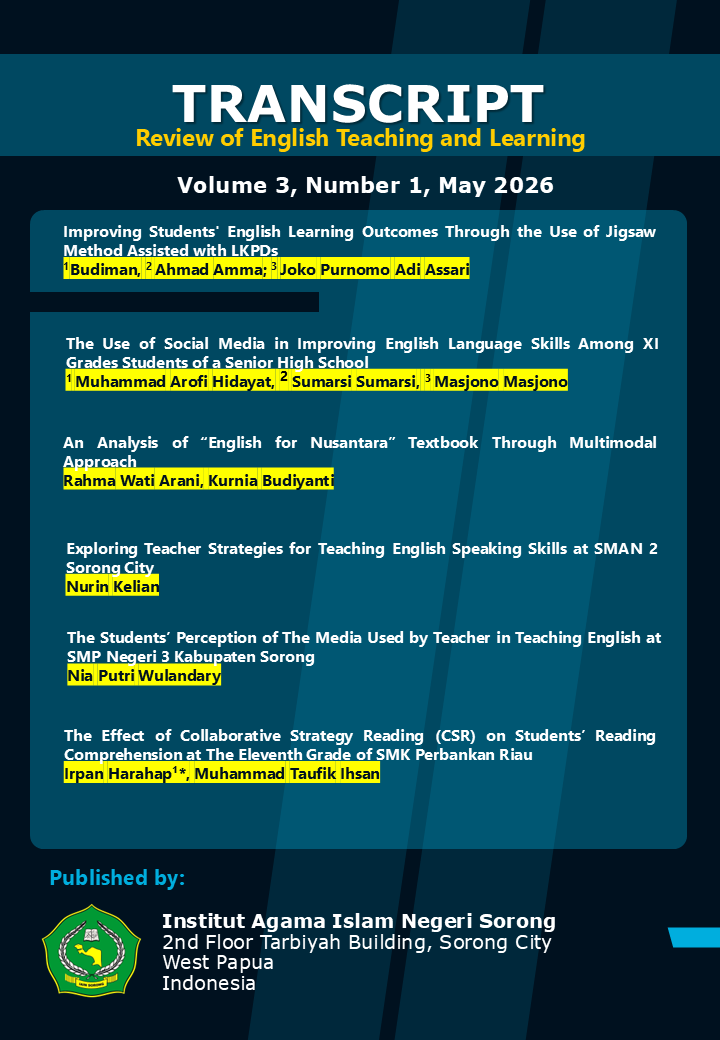
The Effect of Collaborative Strategy Reading (CSR) on Students’ Reading Comprehension at The Eleventh Grade of SMK Perbankan Riau
Keywords:
Reading, Reading Comprehension, Collaborative Reading StrategyAbstract
The purpose of this research to examine the significant difference of the students reading comprehension which taught and without by using Collaborative Strategic Reading (CSR) at the eleventh grade of SMK PERBANKAN RIAU. This research was quasi-experimental design. The sample of this research was 2 group, there were 21 students of X1 MP 2 as the experimental group and there were 22 students of X1 MP 1 as the control group. taken by cluster random sampling. The population of this research was eleventh grade at SMK PERBANKAN RIAU. The techniques of collecting data were multiple choice test. The researcher used independent sample t-test by using SPSS to analyzed the data. The result shown that the sig.2 tailed score was 0.000 < 0.05. It provide that null hypothesis (Ho) was rejected, while the alternative hypothesis (Ha) was accepted. It means that there is a significant effect in the reading comprehension of students who are taught by using collaborative strategy reading with students who are not taught by using collaborative reading strategy of the eleventh grade SMK PERBANKAN RIAU
References
Ahmadi, M. R., & pourhossein, A. G. (2012). Reciprocal teaching strategies and their impacts on English reading comprehension. Theory and Practice in language studies, 2(10), (pp. 2053-2060).
Albadawi, K. H. (2017). The Influence of Reading Comprehension on Reading Fluency. British Journal of English Linguistics, 5(2), 1–8.
Aulia, S. (2020). Collaborative Strategic Reading to Improve Students’ Reading Comprehension on English Education Students at University of Islam Malang.
Barkley, E. E., Cross, K., & Major, H. (2014). Collaborative Learning Techniques. San Fransisco: The Jossey-Bass.
Carrell, P. L. (1989). Metacognitive awareness and second language reading. Modern Language Journal, 73, 120–133.
Chandra, R. (2015). Collaborative Learning for Educational Achievement. Journalof Reseach & Method in Education vol 5.
Creswell, John W. (2012). Educational research: planning, conducting, and evaluating quantitative and qualitative research. Fourth edition. Boston: pearson education, inc.
Fadilah, F. D., Ridwan, N. M., Putri, N. D., Prayoga, S., & Ihsan, M. T. (2021). The role of metacognition strategy to enhance reading comprehension. Jurnal Riset Dan Inovasi Pembelajaran, 1(3), 206-213.
Fanni, W. R. (2021). The Effect of Collaborative Strategic Reading (CSR) Strategy on Students’ Rading Comprehension at Islamic Senior High School AL-KARIM (Doctoral dissertation, Universitas Islam Negeri Sultan Syarif Kasim Riau).
Febtisari, M., & Fitrawati. (2017). Improving Student’s Reading Comprehension of Descriptive Text by Using Collaborative Strategic Reading (CSR) to Eight Grade Students at Junior High School. Journal of English Language Teaching, 6(1), 334–340.
Grabe, W., &Stoller, F. L. (2002). Teaching and researching reading. New York: Pearson Education.
Husniati, W. The Use of Collaborative Strategic Reading to Enhance Students’ Reading Comprehension (A Study on the 7th Grade Students of SMPIT Ar-Risalah Cariu in Academic Year 2020/2021) (Bachelor's thesis, Jakarta: FITK UIN Syarif Hidayatullah Jakarta).
Ihsan, M. T. (2021). The Correlation between Students Reading Habit and Their Writing Ability of Narrative Text. Indonesian Journal of Integrated English Language Teaching, 5(2), 124-130.
Johnson, A. P. (2008). Teaching Reading and Writing: a Guidebook for Tutoring and Remediating Students. Rowman and Littlefield Education.
Kardegar, J., L. (2014). The Comparative Effect of Portfolio, Peer, and Self-Assessment on EFL Learners' Reading Comprehension (Unpublished thesis). Iran: Islamic Azad University at Central Tehran.
King,C. and Stanley, N, (1998). Insight and Strategies for Teaching Reading. Sydney: Harcourt Brace Javanovich Group.
Klingner, J. K. & Vaughn, S. 1998. Using Collaborative Strategic Reading, The Council for Exceptional Children.
Kopitski, M. (2007). Exploring the Teaching of Inference Skills (A Capstone submitted in partial fulfillment of the requirements for the degree of Master of Arts in English as a Second Language). Minnesota: Hamline University.
Kustaryo. 1985. Reading Technique for College Students. Jakarta: DEPSIKBUD.P2LTK.
Longan, J. (2002). Reading and Study Skill: Seventh Edition. Atlanta cape Community College. New York: Published by McGraw-Hill Companies.
Lu, H.S.,& Robert S. (2022). The Role of Collaborative Learning in the Online Education. International Journal of Economic. 6(6), 97-103.
Mickulecky, B. (2011). A Short Course in Teaching Reading. Pearson Education.
Nuttal, C. (1982). Teaching reading skill in a foreign language. London: The`Nemman Educational Ltd.
Pajarwati, D., Mardiah, H., Harahap, R. P., Siagian, R. O., & Ihsan, M. T. (2021). Curriculum reform in Indonesia: English education toward the global competitiveness. ETDC: Indonesian Journal of Research and Educational Review, 1(1), 28-36.
Paramitadharmayanti, P. A., & Artini, D. K. (2013). the Effect of Modified Collaborative Strategic Reading and Vocabulary Mastery on the Reading Competency of the Second Semester Students of English Education Study Program of Mahasaraswati Denpasar University. E-Journal Program Pasasarjana Universitas Pendidikan Ganesha, 1.
Pasquella, A., Gottardo, A., & Grant, A. (2012). Comparing Factors Related to Reading Comprehension in Adolescents Who Speak English as a First (L1) or Second (L2) Language. Scientific Studies of Reading, 16, 475-503.
Prayudi, R. A., Hakiki, A. K., Putra, N. R. D., Anzka, T. O., & Ihsan, M. T. (2021). The use of technology in english teaching & learning process. Jurnal Riset Dan Inovasi Pembelajaran, 1(2), 102-111.
Puspita, M. (2023). The Effect of Collaborative Strategic Reading to Improve Rading Comprehension at State Islamic Senior High School 3 Pekanbaru (Doctoral dissertation, Universitas Islam Negeri Sultan Syarif Kasim Riau).
Rahman, ndah F. (2015). The Implementation of Collaborative Strategy Reading (CSR) and Its Effects on Students’ Reading Comprehension. ETERNAL (English, Teaching, Learning and Research Journal), 1(1), 39–56. https://doi.org/10.24252/eternal.v21.2016.a7
Sharpe, J. P. (2005). How to Prepare the TOEFL Test 11 Edition. Ohio: Barrons Educational Series Inc.
Smith, R, J., and V.L. Dauer. 1984. A Comprehension-Monitoring for Reading Content Area Material.Boston : United States University.
Sugiono. (2016). Metode Penelitian Kualitatif, Kuantitatif dan R&B. Bandung: Alfabeta.
Vener, D. (2002). Landmark School Outreach Program: Finding the Main Idea. (Online)http://www.lndmarkoutreach.org/publications/spotlight/findingmain-idea.
Zoghi, M., Mustapha, R., & Mohd.Maasum, T. N. R. (2010). Collaborative Strategic Reading with University EFL Learners. Jurnal Teknologi, 41(1), 67 94. https://doi.org/10.11113/jt.v56.58
Downloads
Published
How to Cite
Issue
Section
License
Copyright (c) 2026 Transcript: Review of English Teaching and Learning

This work is licensed under a Creative Commons Attribution 4.0 International License.
As a journal writer, you have the right to various uses of your article, including use by the institution or company where you work. This copyright can be used without special permission.
Publishing authors in TRANSCRIPT: Review of Teaching and Learning English have broad rights to use their work for teaching and scientific purposes without the need to seek permission, including use for classroom teaching by Author or Author institutions and presentations at meetings or conferences and distributing copies to participants; used for internal training by the author's company; distribution to colleagues for their research use; used in compilations of the authors' subsequent works; included in a thesis or dissertation; reuse of sections or excerpts from articles in other works (with full acknowledgement of the final article); preparation of derivative works (other than commercial purposes) (with full acknowledgement of the final article); Voluntary posting on open websites operated by authors or authors' bodies for scientific purposes (follow CC by 4.0 license  ).
).
Authors and readers can copy and redistribute the material in any media or format, as well as remix, modify and build the material for any purpose, even commercially, but they must provide appropriate credit (cite the article or content), provide a link to the license, and indicate if anything changes. If you mix, modify, or build upon the materials, you must distribute your contributions under the same license as the originals.