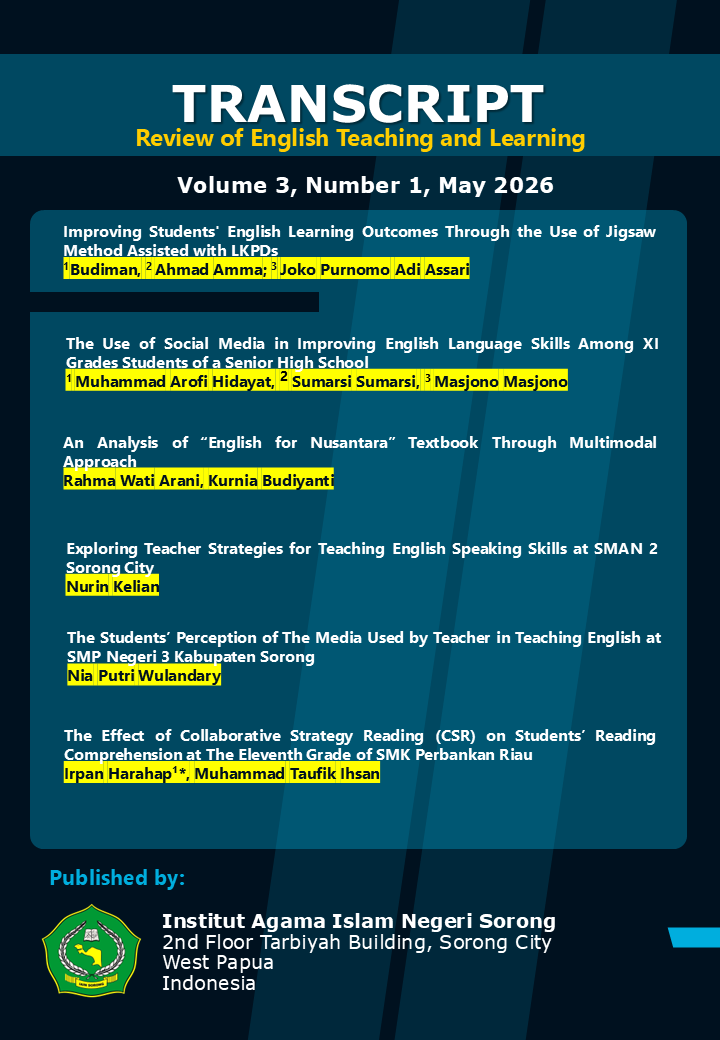
The Students’ Perception of The Media Used by Teacher in Teaching English at SMP Negeri 3 Kabupaten Sorong
Keywords:
Student Perception, Teaching Media, Teaching EnglishAbstract
This study aimed to identify the media used by the teacher in teaching English and the students’ perceptions of these media at SMP Negeri 3 Kabupaten Sorong. The study used a descriptive qualitative approach involving one English teacher and 18 seventh-grade students. Data were collected in September 2022 through observation and interviews. Semi-structured interviews were conducted in Bahasa Indonesia, recorded, transcribed, and translated into English. Data analysis involved data reduction, data display, and verification and conclusion drawing. The findings identified six types of media: a whiteboard, English books, dictionaries, a laptop, an LCD projector, and speakers. Most students expressed positive perceptions of the media used in English lessons. They reported feeling happier, more active, and more enthusiastic; understanding the material more easily; improving pronunciation and vocabulary; finding new ideas; expressing opinions; and relating the material to everyday life. Some students also expressed negative perceptions. They experienced difficulty understanding the material, pronouncing words, finding new ideas, and expressing opinions. Boredom, a hot and noisy classroom, reluctance to participate, and fear of making mistakes were also reported. The study recommended that teachers select varied media appropriate to the material, attend to students who lose focus, and replay media when necessary to help students understand the material.
References
Aprilia Prabawati. 2021. The Students’ Perception Of The Online Media Used By Teacher In Learning English. Thesis English Education Department Faculty Of Teacher Training And Education Muhammadiyah University Of Makassar
Ayu Novita Sari. 2020. The Students’ Perception of The Media Used By Teacher in Teaching English. Journal Faculty of Teacher Training and Education, English Education Study Program, Al wshliyah University Labuhanbatu Rantauprapat, Indonesia
Azhar, Arsyad. 2017. Learning Media . Jakarta: King Grafindo Persada Rineka Cipta
Damayanti, L. 2016.The problems in doing presentations faced by the English department students of IAIN Tulungagung.
Kemp, Jerold E. 2017. Instructional Design . Belmont, California: David S. Lake Publisher
Latuheru, John. D. 2018. Instructional Media and Today Learning Process. Jakarta: Dekdikbud Dirjen Dikti Proyek Pengembangan Lembaga Pendidikan Tenaga Pendidikan.
Marwana Ambo Lele. 2019. The Students’ Perception Of The Media Used By Teacher In Teaching English (Descriptive Research at the Eighth Grade Students of SMP Muhammadiyah 12 Makassar). Thesis English Education Department Faculty Of Teacher Training And Education University Muhammadiyah Of Makassar
Nurjannah Thahir. 2018. Students’ Perception Of The Methods Used By The Teacher In Teaching English At SMA Negeri 13 Pangkep. Thesis English Education Departement Faculty Of Teacher Training And Education University Of Muhammadiyah Makassar
Omenge, R. O., Priscah, J. M. 2016. Understanding the Utilization of Instructional Media in Training Health Professionals. Department of Community Health: Egerton University
Qiong, O. U. 2017. A brief introduction to perception. Studies in Literature and Language, 15(4), 18-28.
Robbins, S.P. and Judge, T.A. 2013. Organisational Behavior. 15th edition. Pearson, Boston.
Ruis, N. 2019. Instructional Media. Jakarta: Ministry of National Educational.
Sugiyono. (2021). Metode Penelitian Kuantitatif, Kualitatif, dan R&D. Bandung: Alfabeta.
Suleiman, Amir Hamzah. 2017. Media Audio-Visual for Teaching. Jakarta: PT Gramedia
Suyanto, S. (2021). A study of vocabulary teaching techniques in an elementary school in SDN Sumurcinde 2 Tuban. EDUTAMA.
Syahroni, M. I. (2022). Quantitative research procedures. E-Jurnal Al Musthafa, 2(3), 43–56.
Wael, A., et al. (2024). The use of word detective method in improving vocabulary in English at SD Istianah Terpadu, Sorong City. JPG: Journal of Teacher Education, 5(2).
Wahyuni, A. T., & Azies, F. (2021). Pengembangan Bahan Ajar Kosakata dalam Pembelajaran Teks Bahasa Indonesia Kelas VIII Semester Gasal Sekolah Menengah Pertama. Metafora: Jurnal Pembelajaran Bahasa Dan Sastra, 8(2), 179. https://doi.org/10.30595/mtf.v8i2.11996
Wu, M., & Marek, M. (2021). Digital game-based learning in the second language classroom: The impact on students' motivation and learning outcomes. Language Learning & Technology, 25(2), 56–76.
Yam, J. H., & Taufik, R. (2021). Hipotesis Penelitian Kuantitatif. Perspektif : Jurnal Ilmu Administrasi, 3(2), 96–102. https://doi.org/10.33592/perspektif.v3i2.1540
Yam, J. H., & Taufik, R. (2021). Quantitative research hypothesis. Perspective: Journal of Administrative Sciences, 3(2), 96–102.
Yudha, H. T., & Mandasari, B. (2021). The analysis of game usage for senior high school students to improve their vocabulary mastery. Journal of English Language Teaching and Learning (JELTL, 2(2), 74–79.
Zaden, James. W Wander. 2018. Social Psychology. New York: Random House.
Zou, Y., Huang, Y., & Xie, H. (2020). Digital game-based vocabulary learning: Where are we and where are we going? Educational Technology Research and Development.
Downloads
Published
How to Cite
Issue
Section
License
Copyright (c) 2026 Transcript: Review of English Teaching and Learning

This work is licensed under a Creative Commons Attribution 4.0 International License.
As a journal writer, you have the right to various uses of your article, including use by the institution or company where you work. This copyright can be used without special permission.
Publishing authors in TRANSCRIPT: Review of Teaching and Learning English have broad rights to use their work for teaching and scientific purposes without the need to seek permission, including use for classroom teaching by Author or Author institutions and presentations at meetings or conferences and distributing copies to participants; used for internal training by the author's company; distribution to colleagues for their research use; used in compilations of the authors' subsequent works; included in a thesis or dissertation; reuse of sections or excerpts from articles in other works (with full acknowledgement of the final article); preparation of derivative works (other than commercial purposes) (with full acknowledgement of the final article); Voluntary posting on open websites operated by authors or authors' bodies for scientific purposes (follow CC by 4.0 license  ).
).
Authors and readers can copy and redistribute the material in any media or format, as well as remix, modify and build the material for any purpose, even commercially, but they must provide appropriate credit (cite the article or content), provide a link to the license, and indicate if anything changes. If you mix, modify, or build upon the materials, you must distribute your contributions under the same license as the originals.