Publishing System
CREAT: Contemporary Research in Education and Teaching implements a structured and transparent editorial workflow to ensure that all submitted manuscripts are evaluated fairly, consistently, and in accordance with recognized standards of scholarly publishing. The editorial process is managed through Open Journal Systems (OJS), an open-source journal management and publishing platform developed by the Public Knowledge Project.
The workflow is designed to maintain academic integrity, editorial independence, transparency, confidentiality, and the quality of published research. Each manuscript passes through several stages, beginning with submission and preliminary screening, followed by editorial assessment, peer review, revision, final decision, production, and publication.
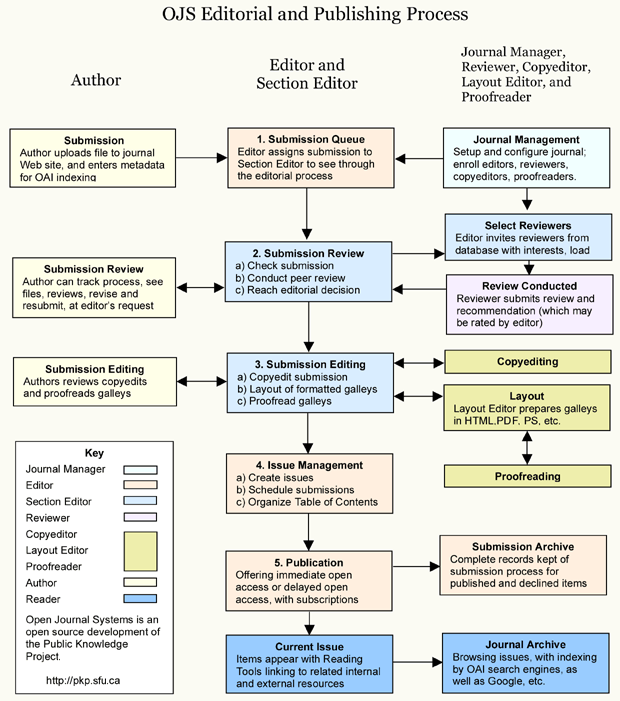
The corresponding author submits the manuscript electronically through the CREAT: Contemporary Research in Education and Teaching OJS platform. Authors are responsible for ensuring that the manuscript complies with the journal's Author Guidelines, formatting requirements, ethical standards, and submission policies. The submission should contain all required components, including the manuscript, author information, declarations, and supplementary materials when applicable.
Upon submission, the editorial office conducts an initial screening to determine whether the manuscript meets the journal's basic submission requirements. This stage includes checking the manuscript structure, completeness of required files, author information, references, formatting, language, ethical declarations, and compliance with the journal's focus and scope.
Submitted manuscripts may be screened for plagiarism, excessive textual similarity, duplicate publication, inappropriate citation practices, and other potential forms of academic misconduct. Where concerns are identified, the editorial team may request clarification from the authors or take appropriate action in accordance with the journal's publication ethics and malpractice policies.
The Editor-in-Chief or a designated editor evaluates the manuscript for its relevance to the journal's focus and scope, originality, academic significance, methodological appropriateness, and potential contribution to the field of education and teaching. Manuscripts that fall outside the journal's scope, fail to meet essential scholarly standards, or present substantial ethical or methodological concerns may be rejected at this stage without external peer review.
Manuscripts that pass the preliminary assessment are assigned to an appropriate Section Editor or handling editor. The assigned editor is responsible for coordinating the peer-review process, selecting qualified reviewers, assessing reviewer reports, communicating decisions to authors, and maintaining the confidentiality and integrity of the editorial process.
The Section Editor identifies and invites independent reviewers with appropriate expertise in the subject area of the manuscript. Reviewers are expected to possess relevant scholarly expertise and to disclose any potential conflict of interest. CREAT generally seeks at least two qualified reviewers for each manuscript considered for external peer review.
CREAT applies a double-blind peer-review process in which, as far as practicable, the identities of authors and reviewers are concealed from one another. Reviewers evaluate the manuscript objectively and provide constructive comments concerning the originality, theoretical foundation, methodology, analysis, interpretation, clarity, references, and overall contribution of the manuscript. Reviewers may recommend acceptance, revision, or rejection. The review process normally takes approximately one month, although the actual duration may vary depending on reviewer availability and manuscript complexity.
After the peer-review reports have been received, the Section Editor evaluates the reviewers' recommendations and comments. Editorial decisions are based on the overall scholarly quality of the manuscript rather than on a single reviewer's recommendation. When reviewer reports substantially differ or additional expertise is required, the editor may seek further reviews before making a decision.
Based on the editorial assessment and peer-review reports, the editor communicates a formal decision to the authors. The possible outcomes include Accept, Minor Revision, Major Revision, or Reject. The decision is communicated through OJS together with relevant reviewer comments and editorial instructions. Editorial decisions are based on academic quality, relevance, originality, methodological soundness, ethical compliance, and the potential contribution of the manuscript.
When revision is requested, authors must revise the manuscript carefully in response to the reviewers' and editor's comments. Authors are expected to provide a clear response to each substantive comment and indicate the changes made in the revised manuscript. Revised manuscripts may be returned to the original reviewers for further evaluation when necessary.
The editor evaluates the revised manuscript and determines whether the authors have adequately addressed the issues raised during the review process. Additional revisions or further peer review may be requested when substantial concerns remain. The final decision is made by the responsible editor in accordance with the journal's editorial policies and quality standards.
Once a manuscript has been formally accepted, it proceeds to the production stage. Copyediting may be conducted to improve language, clarity, consistency, formatting, references, tables, figures, and adherence to the journal's publication standards. Copyediting does not alter the substantive scholarly findings without consultation with the authors.
The accepted manuscript is prepared in the journal's publication layout. The article may undergo technical formatting, typesetting, reference verification, and proofreading. Authors may be asked to review the final proofs and report any factual or typographical errors before publication. At this stage, changes should generally be limited to corrections necessary to ensure accuracy and consistency.
Following completion of the editorial and production checks, the editorial team confirms that the article is ready for publication. The final publication decision is subject to compliance with editorial, ethical, technical, and production requirements.
The final article is published online through the CREAT OJS platform as part of the appropriate journal issue or publication schedule. Published articles receive the bibliographic and persistent metadata required for scholarly identification and citation. The journal also maintains appropriate digital preservation and archiving arrangements to support the long-term accessibility and integrity of the scholarly record.
After publication, CREAT may issue corrections, retractions, expressions of concern, or other editorial notices when necessary to maintain the accuracy and integrity of the scholarly record. Post-publication actions are handled in accordance with the journal's publication ethics policies and recognized principles of responsible scholarly publishing.
CREAT: Contemporary Research in Education and Teaching is committed to conducting its editorial and peer-review processes with fairness, confidentiality, transparency, academic independence, and respect for research integrity. The journal does not guarantee acceptance or a specific publication date. Editorial decisions are based on scholarly merit and the journal's policies rather than personal, institutional, political, or commercial considerations. The workflow may be adjusted when necessary to protect the integrity and quality of the publication process.